Best Electronic Learning Toys for Kids (2026)

"Electronic learning toy" is a category with a split personality. Half of it is genuinely brilliant — coding robots and snap-together circuits that hand a kid real engineering to figure out. The other half is blinking plastic that does the playing for the child while a parent hopes it counts as education. The trick is telling them apart.

So we kept only the toys that make the child do the work — program the path, wire the circuit, solve the drill — every one from a maker with a real track record, with an honest note on what it teaches and which ones still need a grown-up nearby.

🧸 Curating learning toys since 2004 Independent picks · no pay-for-placement

What makes an electronic toy actually teach

The single best filter is this: does the toy respond to the child, or does it just perform? A coding robot sits still until your kid gives it a sequence, then does exactly what they told it — including the mistakes. That gap between "what I meant" and "what it did" is where the learning happens, and it's the same loop whether the child is four and pushing buttons on a robot mouse or eleven and writing real code to make a robot draw. Toys that light up and sing on their own skip that loop entirely.

The other thing worth knowing is that "electronic" and "screen" are not the same thing. Some of the best toys here run on nothing but batteries and never touch a tablet — the robot mouse, the snap circuits, the talking microscope. That matters if you're buying specifically to give a kid something engaging that isn't one more screen. We've flagged the handful that do need an app or iPad so you can steer around them if you want to.

Coding robots & screen-free programming

The best "electronic learning" doesn't mean staring at a screen. These teach real sequencing and debugging logic with a physical robot a kid programs, watches, and fixes — coding you can hold.

Code & Go Robot Mouse Activity Set
Best first coding · Learning Resources

Code & Go Robot Mouse Activity Set

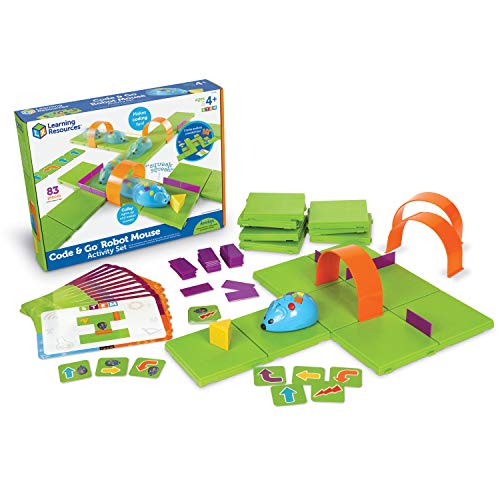
Coding before reading, and entirely screen-free. Kids build a maze with the included walls, then press direction buttons on Colby the mouse to program a path to the cheese — forward, turn, repeat. When the mouse takes a wrong turn, they don't get an error message; they watch it bonk a wall and figure out which step to fix. That debugging loop is the actual point, and it's the clearest hands-on intro to sequencing we've found for fours and up. The 83-piece set has enough maze walls and challenge cards to stay fresh for a couple of years.

Builds: sequencing · logical thinking · spatial reasoning

~$45· See it on Amazon
Botley 2.0 The Coding Robot Activity Set
Best coding robot · Learning Resources

Botley 2.0 The Coding Robot Activity Set

The screen-free coding robot that grows with a kid for years. You program Botley with the remote — no tablet, no app, no account — and he scoots across the floor executing your sequence, then graduates to loops and genuine if/then "object detection" once your child is ready. The 78-piece set comes with obstacles and an arm so Botley can push and haul, which keeps the play physical and social rather than a kid hunched over a screen. It's our top step-up from the robot mouse: the same debugging logic, more horsepower, more room to grow.

Builds: sequencing · loops · if/then logic

~$80· See it on Amazon
Coding Critters Ranger & Zip
Best for preschoolers · Learning Resources

Coding Critters Ranger & Zip

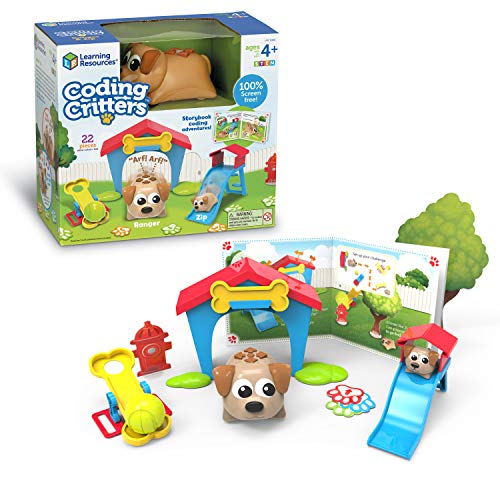
A coding toy disguised as a pet, and that disguise is the whole genius. Ranger is a plush-looking interactive dog a preschooler programs to fetch his bone or find his puppy Zip — they're sequencing steps and debugging a path without ever hearing the word "code." It comes with a storybook that frames the play, so a four-year-old who isn't ready for buttons-and-mazes gets a narrative way in. Cute enough to become a genuine lovey, which is more than you can say for most STEM toys.

Builds: sequencing · storytelling · logic

~$32· See it on Amazon
Artie 3000 The Coding Robot
Best for older kids · Educational Insights

Artie 3000 The Coding Robot

Coding you can see on paper. Artie holds a marker and draws whatever path your kid programs — so an abstract sequence of commands becomes a spirograph, a maze, or their name on the page. It connects to a phone, tablet, or computer and scales from drag-and-drop blocks up to actual JavaScript and Python, which is why it earns its 7+ label and keeps working for a tween. The art-meets-code angle hooks kids who'd never sit through a "learn to code" app — they're chasing a cooler drawing, and the geometry sneaks in.

Builds: block coding · geometry · creativity

~$39· See it on Amazon

Circuits & electronics kits

Where the lights actually turn on. Snap-together circuits give kids the genuine thrill of building the thing that buzzes — from a first space rover up to a 100-project lab.

Jr. SC-100 Electronics Kit
Editor’s pick · Snap Circuits

Jr. SC-100 Electronics Kit

The electronic-learning toy we'd buy first. The parts snap onto a plastic grid like LEGO — no soldering, no loose wires — so a kid wires up a real working circuit that lights a lamp, spins a fan, or blares an alarm in about a minute. The full-color manual walks through 100+ projects in order, and the genuine "aha" lands the moment they realize they built the thing that's buzzing. It's labeled 8+, and that's honest: younger kids will need a grown-up reading the diagrams. The Jr. is the right starting size — you can graduate to the 300- and 500-project sets later without rebuying the base.

Builds: circuit logic · cause & effect · following diagrams

~$30· See it on Amazon
Circuit Explorer Rover
Best circuits + play · Educational Insights

Circuit Explorer Rover

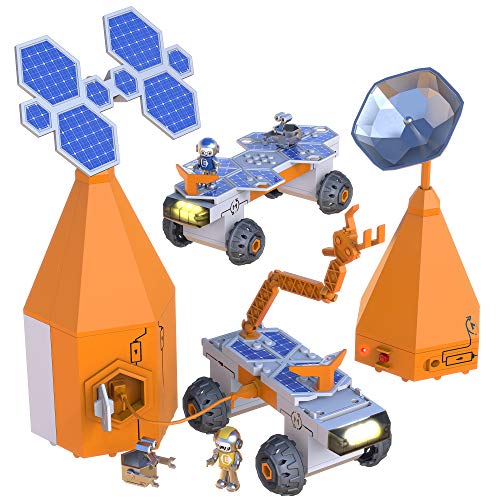
A gentler on-ramp to electronics than a full circuit kit. Kids build a space rover and wire up real working lights and motion as part of the play — the circuit-building is baked into a toy they actually want to drive around, not a bench exercise. It's pitched at 6+ and bridges the gap nicely for a kid who loves pretend play but isn't ready for Snap Circuits' diagrams. The light-up payoff is immediate, which is exactly what keeps a six-year-old building.

Builds: circuit basics · building · imaginative play

~$26· See it on Amazon

Talking & interactive learning

Electronic toys that respond to the child rather than perform on their own — a talking pen, a narrating microscope, a first laptop — built for the pre-reading and early-reading years.

2-in-1 LeapTop Touch
Best for toddlers · LeapFrog

2-in-1 LeapTop Touch

The "my first laptop" that buys you a peaceful car ride. A two- or three-year-old flips it open, mashes the chunky keys, and gets letters, animals, and songs back — it works as a flat tablet or a propped-up laptop, which toddlers find endlessly important. It is a talking, light-up toy, so it does some of the playing for them; we'd treat it as a fun supplement, not the main event. But for the age where a real keyboard is irresistible, it's sturdy, well-made, and far cheaper than the tablet they're actually grabbing for.

Builds: letters · first words · cause & effect

~$30· See it on Amazon
Hot Dots Beginning Phonics Set
Best interactive reading · Educational Insights

Hot Dots Beginning Phonics Set

The talking pen that lets a new reader practice solo and get instant feedback. Kids touch the Hot Dots pen to an answer and it lights up and says "good job!" or an "uh-oh" buzz, so they self-correct without a grown-up hovering — genuinely useful for the phonics drilling that just takes repetition. The interactive pen is the electronic part, and it's the right kind: it responds to the child's choice rather than performing on its own. A low-cost, low-pressure way to build reading confidence for a three- to five-year-old.

Builds: phonics · letter sounds · independent practice

~$19· See it on Amazon
GeoSafari Jr. Talking Microscope
Best talking science · Educational Insights

GeoSafari Jr. Talking Microscope

A real microscope a pre-reader can use alone, because it talks. It's preloaded with slides and narration from wildlife presenter Bindi Irwin — a quiz mode and a fact mode — so a three-year-old peers in, presses a button, and hears what they're looking at instead of needing an adult to read every caption. The talking feature is what makes it work for the age: it hands a non-reader real science vocabulary and the thrill of "I found it myself." A standout first science gift.

Builds: science vocabulary · observation · curiosity

~$35· See it on Amazon

Handheld electronic brain games

Pocket-sized, battery-powered, and built for the back seat: self-paced math fluency and memory challenges that beat a phone for killing time.

MathShark Handheld Math Game
Best math practice · Educational Insights

MathShark Handheld Math Game

Flashcards that fight back. This handheld runs addition, subtraction, multiplication, and division across eight levels, times the kid, and scores them — turning math-fact practice into a beat-your-best game instead of a worksheet. The screen and feedback are the electronic hook, and they work: kids will grind multiplication tables to chase a faster time in a way they never would on paper. Genuinely useful for the rote fluency that just needs reps, and it travels well for a car or a waiting room.

Builds: mental math · fact fluency · self-paced drilling

~$27· See it on Amazon
BrainBolt Memory Game
Best under $20 · Educational Insights

BrainBolt Memory Game

A pocket-sized brain workout with a satisfyingly addictive loop. The handheld flashes a growing sequence of lights and sounds; the kid plays it back, and it keeps adding one more — a pure working-memory challenge that's genuinely hard to put down. Single-player and travel-friendly, so it's the one that lives in a bag for restaurants and road trips. It's labeled 7+ and competes happily against grown-ups, which makes it a sneaky-good family time-killer that isn't a phone.

Builds: memory · focus · pattern recognition

~$17· See it on Amazon

A note on screens, apps & batteries

If your goal is to claw back screen time, lean on the robot mouse, Botley, the Snap Circuits kit, and the talking microscope — all genuinely screen-free. Only Artie 3000 needs a device to program it (and that's also what lets it grow into real JavaScript later). One practical tip: nearly everything here runs on AA or AAA batteries that aren't always in the box, so toss a fresh pack in with the gift — there's nothing worse than a coding robot that won't move on the big morning.

How much to spend

You really don't need to spend much. Several of the best picks are under $35BrainBolt, the Hot Dots phonics set, the Circuit Explorer Rover, MathShark, the LeapTop Touch, and Snap Circuits Jr. all punch above their price. The splurges that earn it are the coding robots — Botley around $80 and the robot mouse around $45 — because they keep working across several years as a child moves from simple sequences to loops and logic.

Frequently asked questions

What are the best electronic learning toys for kids?
For a do-everything pick, the Snap Circuits Jr. SC-100 is hard to beat — kids snap together real working circuits with no soldering. For coding, the Code & Go Robot Mouse (ages 4+) and the step-up Botley 2.0 robot (ages 5+) teach genuine sequencing screen-free. For younger kids, the LeapFrog LeapTop Touch and the GeoSafari Jr. Talking Microscope put interactive learning in pre-readers’ hands. Every toy in this guide comes from an established maker like Learning Resources, Educational Insights, LeapFrog, or Elenco (Snap Circuits).
Are electronic learning toys actually educational, or just blinking plastic?
It depends entirely on the toy. The ones worth buying make the child do the work — coding a robot’s path, wiring a circuit, solving a math drill — and respond to the child’s choices. The ones to skip are the toys that light up and perform on their own while the kid watches passively. As a rule, the more a toy plays by itself, the less your child is learning from it. We chose toys here that require an action and reward genuine problem-solving, not just button-mashing.
What age are coding and circuit toys appropriate for?
Screen-free coding starts surprisingly young: the Code & Go Robot Mouse and Coding Critters work at 4+, because they teach sequencing through play before a child can read. Botley 2.0 robots suit 5+, and marker-drawing or app-connected robots like Artie 3000 are best at 7+. Circuit kits are trickier — Snap Circuits is labeled 8+ and younger kids will need a grown-up reading the diagrams, while the Circuit Explorer Rover bridges the gap at 6+ by baking the circuit into a toy they drive around.
Do these electronic toys need a tablet, app, or internet?
Most of our top picks are deliberately screen-free and need nothing but batteries — the robot mouse, Botley, Coding Critters, Snap Circuits, the talking microscope, and the handheld games all work straight out of the box. The exceptions are Artie 3000, which connects to a phone, tablet, or computer for programming, and Osmo-style kits that require an iPad or Fire tablet. If you want to avoid screens entirely, stick to the robot and circuit picks.
How much should I spend on an electronic learning toy?
You don’t need to spend much for a great one. Several standouts here are under $35 — BrainBolt (~$17), the Hot Dots phonics set (~$19), the Circuit Explorer Rover (~$26), MathShark (~$27), the LeapTop Touch (~$30), and Snap Circuits Jr. (~$30) all punch above their price. The bigger coding robots (Botley around $80, the robot mouse around $45) are the splurges, and they earn it by growing with a child across several years of play.

How we choose — and a word on the links

Educational Toys Planet has specialized in learning toys since 2004. We pick independently, only from established makers, then cross-check every candidate against current availability and the major independent award and expert lists. We don't accept payment for placement.

Affiliate disclosure: the product links here are Amazon Associate links. If you buy through them we may earn a small commission at no extra cost to you — that's what keeps these guides free and updated. Prices change; tap through for Amazon's current figure. Last updated June 2026.

Related guides