Best Toys & Gifts for 7-Year-Olds (2026)

Seven is when it clicks. A seven-year-old can plan three moves ahead, follow a page of instructions, sound out a science guide, and stick with a hard puzzle long enough to crack it. The toys that land now aren't the loud, flashing ones — they're logic games, real building sets, and science kits that hand a curious kid something genuinely meaty to do.

So we kept only toys we'd actually give a seven-year-old — every one from a maker with a real track record, cross-checked against the major expert and award lists, with an honest reason behind each choice.

🧸 Curating learning toys since 2004 Independent picks · no pay-for-placement

What seven-year-olds are working on

Shopping well for this age gets easier once you picture what a seven-year-old is actually practicing. Logical reasoning is the headline: they can now hold a goal in mind and work backward to it, which is exactly why single-player logic games suddenly land. They're reading well enough to follow multi-step instructions on their own — so a build set with 70 models or a science kit with 50 experiments becomes a solo adventure rather than a parent-led one.

Second-grade math is cementing addition and subtraction facts, and the right game (think Math Dice) turns that drill into play. Curiosity about the real world goes wide and deep — rocks, bugs, space, reactions — which is the window where a microscope or a dig kit can spark a genuine interest. And the pull toward screens is real, so the best gifts either skip the screen entirely or, like a coding robot, aim that pull at making something. The throughline: at seven, the best toy is the one that hands the child the thinking.

Brain-stretching games

Seven is the logic-puzzle sweet spot: old enough for real strategy, young enough to be delighted by it. These four are single-player or quick to set up — the kind a kid will pick up again and again on their own.

Rush Hour Junior Traffic Jam Logic Game
Editor’s pick · ThinkFun

Rush Hour Junior Traffic Jam Logic Game

If you buy one logic game at seven, make it this. You slide an ice-cream truck out of a gridlocked car park by moving the other vehicles in the right order — easy to grasp in ten seconds, genuinely hard by the later cards. What makes it stick at this age is the built-in difficulty ladder: 40 challenges from "beginner" to "expert," so a seven-year-old starts winning immediately and is still stumped weeks later. It's a one-player game, which is its quiet superpower — it's the thing they'll actually do alone while you make dinner. The Junior edition is sized right; graduate to the standard Rush Hour around eight or nine.

Builds: sequential planning · logical reasoning · spatial thinking

~$23· See it on Amazon
3-D Brain Teaser Puzzle Game
Best under $15 · Kanoodle

3-D Brain Teaser Puzzle Game

The little pocket puzzle that punches absurdly above its price. You fill a tray with the puzzle-book's pattern using chunky connected beads — only one solution fits, and finding it is a proper "aha." With 200 challenges it scales from simple 2-D layouts to fiendish 3-D pyramids, so seven is right at the start of a runway that lasts for years. It's tiny, takes no batteries, and is the single best thing we know to hand a kid in a car or a restaurant. Made by Educational Insights, the same people behind a lot of classroom staples.

Builds: spatial reasoning · trial & error · persistence

~$11· See it on Amazon
Gravity Maze Builder Marble Run
Best STEM game · ThinkFun

Gravity Maze Builder Marble Run

Part logic puzzle, part marble run, and a seven-year-old's idea of a great afternoon. You place clear towers so a dropped marble threads through them and lands on the target — which means thinking several moves ahead in three dimensions before you ever release the ball. The "Builder" version leans into open design as well as set challenges, so kids invent their own runs once they've cracked the cards. It's the rare STEM toy where the "engineering" is genuinely the fun part, not a label slapped on the box.

Builds: spatial reasoning · planning ahead · cause & effect

~$25· See it on Amazon
Math Dice Junior
Best sneaky math · ThinkFun

Math Dice Junior

Mental math that doesn't feel like a worksheet. You roll the dice and race to reach a target number by adding and subtracting your way there — and because there are many paths to the same answer, a seven-year-old quickly learns to play with numbers instead of fearing them. It's fast, it travels, and it quietly cements the addition and subtraction facts second grade is drilling anyway. A Toy of the Year nominee, and about the cheapest math help you can buy.

Builds: mental math · flexible thinking · number sense

~$11· See it on Amazon

Builders & engineers

Building turns serious at seven — from following plans to inventing from scratch. These three reward patience and grow with a child for years.

Classic Large Creative Brick Box (10698)
Best open-ended · LEGO

Classic Large Creative Brick Box (10698)

Seven is when LEGO stops being about following one set and becomes a real creative medium — and a big tub of mixed classic bricks is what unlocks that. 790 pieces in 33 colors, with windows, wheels, eyes, and a baseplate, means a child can build whatever's in their head rather than the one thing on a box. It pairs with every themed set you already own, the lid doubles as storage (a small mercy), and the cost-per-hour over the next few years is close to nothing. The one toy on this list most likely to still be in use at eleven.

Builds: creativity · fine motor · engineering

~$40· See it on Amazon
70 Model Building Set
Best builder · K’NEX

70 Model Building Set

Where LEGO builds blocky, K'NEX builds skeletal — rods and connectors that snap into wheels, gears, and structures that actually move. 705 pieces and instructions for 70 different models (cars, animals, machines) give a seven-year-old the satisfying loop of following a plan, making it work, then breaking it down to build the next. It demands a bit more finger strength and patience than LEGO, which is exactly right at this age. Great for the kid who likes their building to roll, spin, or do something.

Builds: engineering · following plans · problem solving

~$43· See it on Amazon
Roller Coaster Challenge Building Game
Best logic + build · ThinkFun

Roller Coaster Challenge Building Game

A brilliant hybrid: a logic puzzle you build, then ride. The challenge cards tell you which posts and track pieces must go where, and you have to figure out the rest so a real car can coast the loop without flying off. There are 40 challenges of rising difficulty, and the moment a kid sends the marble-car down a track they engineered themselves is genuinely thrilling. A Toy of the Year finalist, and one of the few "STEM" toys that earns the buzzword honestly.

Builds: spatial planning · logic · engineering

~$38· See it on Amazon

Young scientists & explorers

This is the age of relentless "why?" Good science kits answer it with their hands, not a screen — real reactions, real specimens, real magnification.

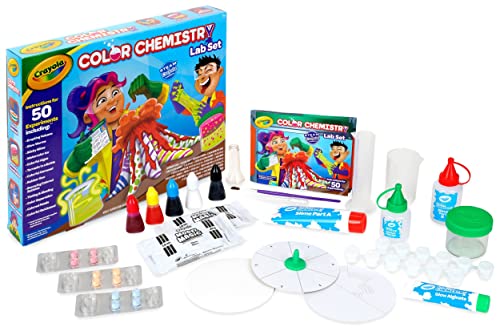
Color Chemistry Set (50 Experiments)
Best first science · Crayola

Color Chemistry Set (50 Experiments)

A real, safe first chemistry set from a brand parents already trust not to be sketchy. The 50 experiments — color-changing reactions, fizzing, crystals, invisible ink — are the kind that make a seven-year-old gasp, and they come with clear, kid-readable steps rather than a wall of fine print. Most use the kit's own materials plus a few kitchen staples. It needs a bit of grown-up supervision, which is part of the appeal: it's a thing you do together at the kitchen table.

Builds: scientific method · observation · following steps

~$30· See it on Amazon
Mega Fossil & Gemstone Dig Kit
Best hands-on · National Geographic

Mega Fossil & Gemstone Dig Kit

Twenty genuine fossils and gemstones buried in a plaster brick, dug out with the included tools — and for a dinosaur-or-rocks seven-year-old, that's pure gold. The dig is slow and a little messy (do it outside or over newspaper), which is the point: it rewards patience, and every chip reveals a real specimen they get to keep and identify with the learning guide. It turns "I'm bored" into a focused hour. Pairs beautifully with the microscope below.

Builds: patience · curiosity · fine motor

~$30· See it on Amazon
Junior Microscope Kit for Kids
Best explorer tool · National Geographic

Junior Microscope Kit for Kids

The toy that makes the ordinary world strange and fascinating. A handheld scope up to 250x magnification, with prepared slides and a guide, lets a seven-year-old see that a leaf, a feather, or a grain of salt is wildly more interesting up close than they imagined. It's robust and genuinely kid-operable — not a fragile lab instrument — so they can carry it around and aim it at whatever they find. The gift that quietly turns a curious kid into someone who investigates.

Builds: observation · curiosity · careful handling

~$33· See it on Amazon

Coding & making

For the kid drawn to screens, a way to point that pull at creating instead of consuming.

Artie 3000 The Coding Robot
Best first coding · Educational Insights

Artie 3000 The Coding Robot

Screen time with something to show for it. Artie is a little drawing robot you program — by dragging blocks or typing simple commands — to roll across paper and draw shapes and patterns. A seven-year-old gets the core idea of coding (a sequence of instructions makes a thing happen) and instant, physical feedback: the drawing is right, or it's hilariously wrong and they debug it. It grows with the child from drag-and-drop blocks toward real text-based code. The best on-ramp to programming on this list.

Builds: coding logic · sequencing · cause & effect

~$39· See it on Amazon

A note on the "ages 8+" labels

You'll see some of the best toys for this age — the standard Rush Hour, Gravity Maze, many science kits — boxed as "8+." Those labels are conservative, set partly for small parts and partly for legal caution. A capable, interested seven-year-old handles most of them fine, especially with a grown-up nearby for the first session. We've leaned toward the junior or 6+/7+ versions here where they genuinely fit better, and flagged where the older edition is the natural next step.

How much to spend

You really don't need to spend much. Two of the best picks here are under $15Kanoodle and Math Dice Junior — and both travel anywhere. The $20–30 sweet spot (Rush Hour Junior, Gravity Maze, the chemistry set, the dig kit) is where most generous birthday gifts land. And the $38–43 splurges — a big LEGO brick box, the K'NEX 70-model set, Roller Coaster Challenge, or Artie the coding robot — each last so many years the cost-per-play is tiny.

Frequently asked questions

What are the best educational toys for a 7-year-old?
Our top pick is ThinkFun Rush Hour Junior — a single-player logic game with a built-in difficulty ladder a seven-year-old won’t outgrow for a year or two. For range, mix categories: a brain game (Rush Hour or Kanoodle), an open-ended builder (LEGO Classic or K’NEX), a hands-on science kit (a Color Chemistry set or a Nat Geo dig kit), and one coding toy (Artie 3000). Every toy in this guide comes from an established maker like ThinkFun, LEGO, Educational Insights, or National Geographic.
How much should I spend on a gift for a 7-year-old?
You don’t need to spend much. Some of the best toys here are under $15 — Kanoodle and Math Dice Junior both punch far above their price and travel anywhere. The $20–30 band (Rush Hour Junior, Gravity Maze, the Crayola chemistry set, a Nat Geo dig kit) is where most generous birthday gifts land. The $38–43 items — a big LEGO brick box, the K’NEX 70-model set, Roller Coaster Challenge, or Artie the coding robot — are splurges that last for years, so the cost-per-play stays tiny.
What skills should toys build at age 7?
Seven is a big year for logical reasoning, planning ahead, and reading-to-do (following multi-step instructions). Logic games like Rush Hour and Gravity Maze build sequential thinking; building sets like LEGO and K’NEX build spatial reasoning and persistence; science kits build observation and the scientific method; and a coding toy like Artie introduces the idea that a sequence of instructions makes something happen. The common thread: toys where the child does the thinking, not toys that perform for them.
Are logic puzzles too hard for a 7-year-old?
No — the good ones are designed to scale. Rush Hour Junior, Kanoodle, and Gravity Maze all start with beginner challenges a seven-year-old solves quickly, which builds the confidence to attempt harder ones. That difficulty ladder is the whole point: a child experiences early wins, then keeps reaching. If a particular challenge is frustrating, just drop back to an easier card — there’s no penalty, and that’s how persistence gets built.
What are good non-screen gifts for a 7-year-old?
Nearly everything in this guide is screen-free: logic games, LEGO and K’NEX building sets, a chemistry set, a fossil dig kit, and a microscope all pull a kid into focused, hands-on play with no battery or screen involved. The one exception, Artie 3000, is a coding robot — it does involve a device to program it, but it points that screen pull toward making something rather than passive watching, and the result is a drawing on real paper.

How we choose — and a word on the links

Educational Toys Planet has specialized in learning toys since 2004. We pick independently, only from established makers, then cross-check every candidate against current availability and the major independent award and expert lists. We don't accept payment for placement.

Affiliate disclosure: the product links here are Amazon Associate links. If you buy through them we may earn a small commission at no extra cost to you — that's what keeps these guides free and updated. Prices change; tap through for Amazon's current figure. Last updated June 2026.

Related guides