Best Toys for Babies 0–12 Months (2026)

A baby changes more in twelve months than at any age that follows. The newborn who can only stare at a high-contrast pattern becomes, by the first birthday, a sitting, grabbing, peek-a-boo-loving explorer. The trick to shopping for the first year is to stop thinking about "baby toys" as one thing and start thinking in stages — what works at six weeks is wasted at six months, and the reverse.

So we sorted these by what a baby is actually doing — looking, grabbing, then sitting up and figuring things out — and kept only toys we'd give our own. Every one is from a maker with a real track record, washable, and chosen because it earns its place, not because it blinks.

🧸 Curating learning toys since 2004 Independent picks · no pay-for-placement

How a baby’s play changes across the first year

Newborns can't reach or hold — for the first couple of months they're working on focusing their eyes and discovering they have hands. That's why the earliest "toys" are really things to look at and lie under: a play gym overhead, a tummy-time mirror, high-contrast patterns. The single most valuable thing you can do is tummy time, because the neck and core strength it builds is the foundation for rolling, sitting, and crawling — and a mirror or a crinkly fish is how you buy a few more minutes of it.

Around three to four months the hands switch on: a baby starts swiping at the dangling toys, then grabbing, then — the big one — bringing everything to the mouth (the mouth is how a baby this age explores, so everything has to be chewable and washable). By six months most babies can sit with support and use two hands, which unlocks a new kind of play: stacking rings, dropping things to watch them fall, and lift-the-flap peek-a-boo as they grasp that hidden things still exist. Pick for the stage the baby is in now, and you'll get far more play out of far less stuff.

From day one (0–3 months)

A newborn can't hold anything yet — they're working on focusing their eyes and finding their hands. These toys do the playing near the baby until the baby is ready to join in.

Freddie the Firefly Clip-On
Editor’s pick · Lamaze

Freddie the Firefly Clip-On

If you buy one baby toy, the case for Freddie is that he does a little of everything a 0-to-12-month-old needs and clips to the thing the baby is already strapped into. The wings crinkle, the antennae are chewy, the textures and high-contrast patterns give new eyes something to lock onto, and the whole thing is washable and light enough for a four-month-old to bat at. He earns his keep most in the car seat and stroller, where a bored baby and a clip-on toy is the difference between a calm errand and a meltdown. Plush, no batteries, and genuinely hard to wear out.

Builds: visual tracking · grasping · cause & effect

~$15· See it on Amazon
Artful Skwish Wooden Rattle
Best for newborns · Manhattan Toy

Artful Skwish Wooden Rattle

A modern classic, and the rare wooden toy that works from the newborn weeks. The Skwish is a sphere of wooden rods and elastic that collapses when squeezed and springs back open — endlessly fascinating to a baby just discovering that their hands make things happen. The slim dowels are exactly the right diameter for a two- or three-month-old's first real grasp, the beads rattle softly, and there's nothing to break or wear out. It's pricier than a plastic rattle, but it's the one we'd keep.

Builds: grasping · hand-eye coordination · cause & effect

~$21· See it on Amazon
Wooden Baby Play Gym
Best play gym · B. toys

Wooden Baby Play Gym

A play gym is the toy that works from day one, before a baby can hold anything: you lay them underneath and the dangling toys give their eyes something to track and, soon, their hands something to swat. This wooden-arch version skips the loud lights-and-music base most gyms come with — it's calmer to look at and nicer in a living room — and the three hanging toys clip off to reuse on a stroller. Babies grow into it: tracking at six weeks, deliberate batting by three months, grabbing and gumming by five.

Builds: reaching · visual tracking · batting

~$24· See it on Amazon

Grab, mouth & explore (3–6 months)

Once a baby starts swiping and bringing things to their mouth, the whole world becomes graspable and chewable. Light, washable, easy-to-hold toys win here.

Oball Easy-Grasp Classic Ball
Best under $5 · Bright Starts

Oball Easy-Grasp Classic Ball

The smartest five dollars in the nursery. The Oball is a flexible web of soft plastic loops, which is the whole trick: tiny fingers that can't yet grip a smooth ball can hook into the holes, so a baby who'd drop everything else can actually hold this and pass it hand to hand. It's feather-light (won't hurt when it lands on a face), squishes flat and pops back, and survives the dishwasher. We reach for it the moment a baby starts swiping at things around three to four months.

Builds: grasping · hand transfer · reaching

~$5· See it on Amazon
Tummy Time Floor Mirror
Best for tummy time · Sassy

Tummy Time Floor Mirror

Tummy time is the work of the first six months — it builds the neck and core strength a baby needs to roll, sit, and eventually crawl — and most babies hate it. A mirror is the oldest trick for buying more minutes of it: babies are riveted by faces, including their own, so they'll lift and hold their head longer just to keep looking. This one stands up on its own, has high-contrast patterns around the frame, and folds flat. It quietly makes the least-loved part of the day a little less of a battle.

Builds: neck & core strength · visual focus · self-discovery

~$15· See it on Amazon
Flip Fish Sensory Toy
Best sensory · Melissa & Doug

Flip Fish Sensory Toy

A floppy fabric fish loaded with the stuff babies actually fixate on: crinkle, a peekaboo flap, a baby-safe mirror, a teether fin, ribbon tags, and contrasting colors. The genius is the tags — for reasons no parent fully understands, babies are obsessed with fabric tags, and this gives them a whole school of them. It works flat during tummy time and travels well, and the variety means it holds a baby's attention across the long stretch from grabbing to gumming to exploring.

Builds: tactile exploration · grasping · tummy-time interest

~$23· See it on Amazon
Textured Multi-Ball Set
Best for grasping · Infantino

Textured Multi-Ball Set

Six soft balls, each a different texture, color, and pattern — bumpy, ribbed, soft-spiky — so every grab feels different to little hands learning to tell surfaces apart. They're sized for a baby to palm and pass hand to hand, they're chewable, and once a baby is sitting and then crawling, a ball that rolls just out of reach is the best motivation to chase there is. Simple, cheap, and one of those toys that quietly does more developmental work than the flashy stuff.

Builds: grasping · tactile discrimination · rolling & chasing

~$14· See it on Amazon

Sitting up & figuring things out (6–12 months)

A baby who can sit and use two hands is suddenly ready for cause-and-effect: stacking, dropping, peeking, and the dawn of "where did it go?"

Baby’s First Blocks & Rock-a-Stack
Best for 6–12 months · Fisher-Price

Baby’s First Blocks & Rock-a-Stack

Two genuine classics in one box, and both come alive right when a baby learns to sit and use two hands, around six months. The Rock-a-Stack's rings teach the very first idea of order and size as they go on the post (the early game is really just pulling them off — that's a skill too), and the shape-sorter bucket's ten blocks drop through matching holes. It's the toy that bridges from batting-and-mouthing into purposeful play, and it lasts well past the first birthday.

Builds: hand-eye coordination · shape recognition · sitting play

~$18· See it on Amazon
One Two Squeeze Soft Blocks
Best soft blocks · B. toys

One Two Squeeze Soft Blocks

Ten soft, squishy blocks a baby can grab, gum, squeak, and — eventually — stack and knock down. The fabric-feel surface is easy for clumsy hands to hold, they're printed with animals, numbers, and textures to look at up close, and because they're soft there's no hard corner to bonk a head or a sibling. Early on it's all mouthing and squeezing; by ten or eleven months the stacking-and-toppling game begins, which babies find hysterical. Light, quiet, and washable.

Builds: grasping · cause & effect · sensory play

~$15· See it on Amazon
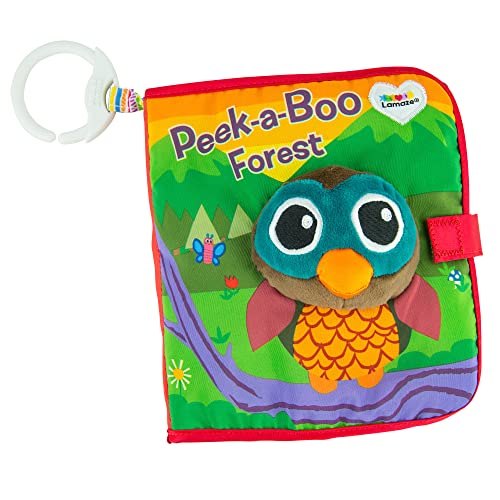
Peek-A-Boo Forest Soft Book
Best first book · Lamaze

Peek-A-Boo Forest Soft Book

A cloth book is the right first book — a baby can chew the corners, crumple the crinkly pages, and not tear a thing. This one hides little animals under flaps, which is perfect for the second half of the first year, when peek-a-boo suddenly delights a baby because they're just grasping that things still exist when hidden. It clips to a car seat or bag, the pages crinkle, and reading aloud over it — even nonsense narration — is some of the best early language exposure there is.

Builds: language exposure · fine motor · object permanence

~$15· See it on Amazon
Water-Filled Teethers (3-Pack)
Best for teething · Infantino

Water-Filled Teethers (3-Pack)

Teething is the misery that defines a big chunk of months three through twelve, and a cold, chewable surface is the cheapest real relief there is. You chill these in the fridge (not the freezer — they stay pliable), and the textured, water-filled surface feels good on sore gums. The shapes have easy-grab handles sized for small hands learning to steer a toy to their own mouth, which is a coordination win on top of the soothing. A three-pack means one's always cold and ready.

Builds: oral soothing · grasping · self-feeding to mouth

~$8· See it on Amazon

A note on safety

Everything a baby touches goes in the mouth, so the rules are simple and non-negotiable: no small parts that could come loose and choke, no cords or ribbons longer than about six inches, BPA-free for anything chewable, and always follow the age guidance printed on the box. Soft, light, washable, and one solid piece is the safest profile for the youngest babies — and conveniently describes most of the picks above.

How much to spend

Almost nothing, if you don't want to. Babies are gloriously unimpressed by price, and several of the best toys here are under $15 — the Oball is about five dollars, the water teethers and textured balls are under fourteen, and Freddie the Firefly is about fifteen. The $18–24 range (the Fisher-Price stacking set, the wooden play gym, the Skwish) is where a generous shower or first-birthday gift lands. There's no splurge tier here on purpose: in the first year, more expensive almost never means better.

Frequently asked questions

What are the best toys for a baby under one year old?
Match the toy to the stage. For a newborn (0–3 months), a play gym, a clip-on sensory toy like the Lamaze Freddie the Firefly, and a tummy-time mirror do the work while the baby just looks and bats. From 3–6 months, easy-grasp toys like the Oball and textured balls suit a baby learning to hold and mouth things. From 6–12 months, a baby who can sit is ready for stacking rings, soft blocks, and lift-the-flap books. Every toy here is from an established maker like Lamaze, Fisher-Price, Manhattan Toy, or Melissa & Doug.
What toys actually help a baby’s development in the first year?
Tummy-time toys (a mirror, a floppy crinkle fish) are the most important early on — tummy time builds the neck and core strength a baby needs to roll, sit, and crawl. Easy-grasp toys (Oball, Skwish, textured balls) build the hand control and hand-to-hand transfer that come before everything else. And cause-and-effect toys in the second half of the year (stacking rings, lift-the-flap books, soft blocks) build the idea that a baby’s own actions change the world. You don’t need much — a handful of well-chosen basics beats a bin of plastic.
How much should I spend on a gift for a baby?
Very little, honestly. Some of the best baby toys are under $15 — the Oball is about $5, the Infantino water teethers and textured ball set are under $14, and the Lamaze Freddie the Firefly is about $15. A wooden play gym or the Manhattan Toy Skwish ($21–24) makes a generous shower or birthday gift. Babies are famously indifferent to price; a $5 Oball gets chewed as lovingly as anything in the room.
Are wooden or plastic toys better for babies?
Both have a place, and safety matters more than the material. Wooden toys like the Skwish are durable, naturally textured, and pleasant to hold; soft plastic like the Oball is light, squishy, dishwasher-safe, and easy for weak hands to grip. The things that actually matter for a baby this age: no small parts that could be a choking hazard, no loose strings, BPA-free if it’ll be chewed (everything will be chewed), and washable. We’ve mixed wood, fabric, and soft plastic in this guide for exactly that reason.
What is the safest kind of toy for a newborn?
For the first few months, the safest and most useful toys are ones the baby looks at and bats rather than holds: a play gym overhead, a propped tummy-time mirror, and a clip-on toy on the car seat. Avoid anything with small detachable parts, long cords or ribbons over about six inches, or button batteries within reach. Soft, washable, lightweight, and one piece is the rule — and always follow the age guidance on the box.

How we choose — and a word on the links

Educational Toys Planet has specialized in learning toys since 2004. We pick independently, only from established makers, then cross-check every candidate against current availability and the major independent award and expert lists. We don't accept payment for placement.

Affiliate disclosure: the product links here are Amazon Associate links. If you buy through them we may earn a small commission at no extra cost to you — that's what keeps these guides free and updated. Prices change; tap through for Amazon's current figure. Last updated June 2026.

Related guides