

Best Developmental Toys for Babies (2026)

A baby's "play" is real work. In the first year, a baby is learning that their hands belong to them, that dropping a thing makes it reappear, and that kicking can make music happen. The best baby toys aren't the ones that blink and sing on their own — they're the simple ones that respond to what the baby does, because that's where development actually lives.

So we kept only toys we'd give a real baby — each from a maker with a track record, grouped by the stage it suits, with an honest reason behind every pick. No "stimulate their genius" marketing, just toys that do the job.

🧸 Curating learning toys since 2004 Independent picks · no pay-for-placement

How to shop for a baby by stage

Babies change fast, so the right toy at three months is the wrong toy at ten. In the first half-year, a baby is mostly lying down, working on head control and the astonishing discovery of their own hands — so high-contrast things to look at, easy-to-grab rattles, and a play gym that rewards a kick or a swat are what land. Tummy time is a battle most babies would rather skip, and a good sensory toy is how you coax out a few more minutes of it.

From six months to a year, a baby sits up and the world becomes things to bang, drop, and reach for. This is the golden age of cause-and-effect: put a ball in the top, it comes out the bottom; pull the ring off, it comes off. Around the first birthday, the timeless classics — shape sorters, ring stackers, bead mazes — finally start to click as real little puzzles. Across all of it, the rule holds: the toy that makes the baby do the work beats the one that performs for them.

For the newest babies (0–6 months)

In the first half-year, a baby is working on two huge things: discovering their own hands, and lifting their head. These reward exactly that — high-contrast looking, easy grasping, and a reason to tolerate tummy time.

Glow & Grow Kick & Play Piano Gym
Best from day one · Fisher-Price

Glow & Grow Kick & Play Piano Gym

If you buy one toy before a baby is born, make it this. The piano hangs at the baby's feet, so the very first weeks of lying-on-back batting turn into kick-the-keys-and-music-plays — the earliest cause-and-effect a newborn can pull off, and the thing that makes them light up. As they grow, the overhead arch with its dangling toys pulls them up onto their elbows for tummy time, and eventually they sit and play the piano by hand. It genuinely earns its keep from week one to about a year, which is rare at this age.

Builds: tummy time · cause & effect · gross motor

~$40· See it on Amazon
Artful Skwish Rattle
Best grasping toy · Manhattan Toy

Artful Skwish Rattle

A genuine classic, and the toy I'd hand a three-month-old who's just discovering their hands. The slatted wooden structure collapses and springs back when squeezed, so tiny fingers can grab it from any angle — there's no wrong way to hold it — and the small beads inside rattle softly as it moves. It's the rare baby toy made of wood and elastic rather than plastic and batteries, and it does exactly the one thing a newborn is working on: figuring out that their hands belong to them.

Builds: grasping · hand-eye coordination · cause & effect

~$21· See it on Amazon
Flip Fish Tummy Time Toy
Best for tummy time · Melissa & Doug

Flip Fish Tummy Time Toy

Tummy time is a hard sell for most babies, and a good sensory toy is how you buy a few more minutes of it. This soft fish has crinkly fins, a peek-a-boo flip body, a mirror, a teether, and different textures on every surface — exactly the kind of high-contrast, do-something variety that keeps a baby propped up and reaching instead of face-planting in protest. It's also machine-washable and packs flat for the diaper bag, which matters more than you'd think.

Builds: sensory exploration · neck strength · fine motor

~$23· See it on Amazon
Oball Easy-Grasp Classic Ball
Best under $5 · Bright Starts

Oball Easy-Grasp Classic Ball

The best five dollars in baby toys. It's a flexible ball made entirely of soft, interlocking loops, which means a baby can grab it with one finger from any angle — far easier than a smooth ball at the age when grabbing is the whole project. It's light enough to throw with no damage, easy to pass hand to hand, and a favorite to chew. We'd buy two: one for the house, one permanently in the car or stroller, because it's the toy that always gets dropped and always gets picked back up.

Builds: grasping · gross motor · hand-eye coordination

~$5· See it on Amazon
Freddie the Firefly Clip-On
Best on-the-go · Lamaze

Freddie the Firefly Clip-On

The classic stroller-and-car-seat toy, and for good reason. Freddie clips onto anything — carrier, stroller bar, car-seat handle — so a fussy baby on the move has crinkly wings, ribbon tags, contrasting patterns, and a chewable face to work through instead of crying. The high-contrast black-white-red is deliberately easy for young eyes to track, and the clip means it doesn't end up on the floor of the grocery store every thirty seconds. A baby-shower staple that actually gets used to death.

Builds: sensory exploration · visual tracking · fine motor

~$15· See it on Amazon

Sitting up & figuring things out (6–12 months)

Once a baby sits steadily, the world becomes things to bang, drop, and reach for. This is the age of cause-and-effect — and the first toys they'll genuinely play with rather than just mouth.

One Two Squeeze Soft Blocks
Best soft blocks · B. toys

One Two Squeeze Soft Blocks

Ten squishy blocks a baby can stack, squeeze, chew, and — best of all — knock down, which is the part they actually love. Each one is embossed with numbers, animals, and shapes and makes a soft squeak or rattle, so it's a sensory toy first and a "learning" toy a long way second (exactly the right order at this age). They're soft enough that a tower toppling onto a face is a giggle, not a crisis, and they wipe clean. A good bridge from pure-baby toys toward real building.

Builds: stacking · sensory exploration · early counting

~$15· See it on Amazon
Bop & Drop Ball Tower
Best cause & effect · Infantino

Bop & Drop Ball Tower

Drop a ball in the top, watch it bonk and tumble down through the tower, retrieve it, do it again roughly four hundred times. That loop — I put it in, it comes out down there — is pure object-permanence and cause-and-effect, the cognitive leap a baby around a year is wired to practice obsessively. It builds the hand-eye aim of placing a ball in a hole, and the balls are big enough not to be a choking worry. Be warned: it's a toy they'll demand you reset over and over.

Builds: cause & effect · object permanence · hand-eye coordination

~$22· See it on Amazon
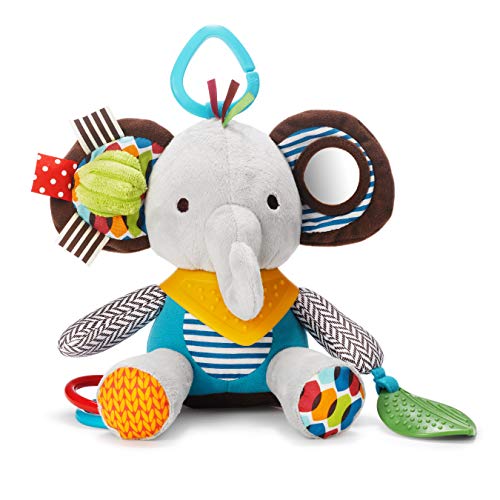
Bandana Buddies Elephant
Best teether · Skip Hop

Bandana Buddies Elephant

A plush activity-and-teething toy built for the months when everything goes in the mouth. The elephant wears a textured bandana with a built-in teether, a crinkle face, a rattle, a squeaker, and a baby-safe mirror — a lot of different sensations packed into one grabbable, washable animal. It's lightweight enough for small hands to maneuver and soft enough to gnaw on without worry, and the variety is what keeps a teething baby distracted from sore gums.

Builds: teething relief · sensory exploration · grasping

~$17· See it on Amazon

First-birthday classics

The toys that bridge into toddlerhood: stacking, sorting, and threading. None of them blink or talk — they hand the baby something real to figure out, and most last for years.

Baby’s First Blocks
Best first shape sorter · Fisher-Price

Baby’s First Blocks

The shape sorter nearly everyone's baby has owned, because it just works. Ten chunky blocks drop through matching holes in the lid of a bucket that doubles as storage — and long before a baby can actually match a shape, they'll love dumping the whole thing out and starting over (the dumping is the play). Around a year it becomes a real puzzle: square goes in the square, and the satisfied face when it drops through is the whole point. Cheap, indestructible, and a genuine developmental staple.

Builds: shape recognition · problem solving · fine motor

~$10· See it on Amazon
Rainbow Stacker Wooden Rings
Best ring stacker · Melissa & Doug

Rainbow Stacker Wooden Rings

The wooden version of the toy every developmental checklist mentions. Babies start by yanking the rings off — easy, instant win — and only much later figure out stacking them back in order, biggest to smallest, which is real early sequencing and size comparison. The rounded post is sized for clumsy hands, the colors are bright and solid, and because it's wood rather than plastic it's the one that survives to become a hand-me-down. Pairs naturally with a shape sorter as a first-birthday duo.

Builds: size sequencing · hand-eye coordination · color

~$10· See it on Amazon
First Bead Maze
Best fine motor · Melissa & Doug

First Bead Maze

The wooden bead maze you've seen in every pediatrician's waiting room, shrunk to a size that suits a high-chair tray or the floor. Sliding the chunky beads along the curved wire tracks is a surprisingly good fine-motor and hand-eye workout, and because the beads never come off, it's the rare toy you can hand over without policing small parts. Its suction-style base keeps it from sliding around. Quiet, battery-free, and genuinely absorbing for a one-year-old.

Builds: fine motor · hand-eye coordination · color

~$13· See it on Amazon

A note on safety

At this age, assume everything goes in the mouth — that's not misbehavior, it's how babies explore. Every toy on this list is chosen with that in mind: no small parts that detach, nothing small enough to choke on, and washable where it counts. Steer well clear of anything with button batteries, loose magnets, or removable small pieces until long past the baby stage, and give toys a quick check for wear now and then. When in doubt, simpler and bigger is safer.

How much to spend

Baby toys are where a small budget goes furthest. Several of the best here are under $15 — the Oball (~$5), the Baby's First Blocks and Rainbow Stacker (~$10 each), and the bead maze all punch far above their price. The $15–23 range (Lamaze firefly, soft blocks, Skwish, Bop & Drop) is the baby-shower sweet spot. The one splurge worth it is the Kick & Play Piano Gym (~$40) — used daily from birth to a year.

Frequently asked questions

What are the best developmental toys for a baby?
It depends on age, which is why we grouped them. For a newborn to six months, a play gym (the Fisher-Price Kick & Play Piano), a grasping toy (Manhattan Toy Skwish), and a tummy-time sensory toy (Melissa & Doug Flip Fish) cover the bases. From six to twelve months, add cause-and-effect (Infantino Bop & Drop) and a teether. Around the first birthday, the classics — a shape sorter, a ring stacker, and a bead maze — start to really click. Every toy here is from an established maker like Fisher-Price, Melissa & Doug, or Manhattan Toy.
What toys actually help a baby’s development?
The unglamorous ones. Babies develop by doing the work themselves — grasping, mouthing, reaching, dropping, and banging — so the most useful toys are simple things that respond to a baby’s own action: a ball they can grab from any angle, a stacker they can pull apart, a tower that drops a ball when they put one in. As a rule, the more a toy lights up and performs on its own, the less the baby is actually doing. High-contrast patterns, varied textures, and cause-and-effect beat batteries.
How much should I spend on a baby gift?
Not much at all. Some of the most-used baby toys are the cheapest: a Bright Starts Oball is about $5, and both the Fisher-Price Baby’s First Blocks and the Melissa & Doug Rainbow Stacker are around $10. A $15–22 toy like the Lamaze firefly, a soft block set, or the Bop & Drop tower makes a generous baby-shower gift. The one bigger-ticket pick worth it is the Kick & Play Piano Gym (~$40) — it’s used daily from birth to about a year.
Are wooden baby toys better than plastic ones?
Neither is automatically better, but wood has real advantages for a few classics. Wooden toys like the Skwish, the Rainbow Stacker, and the bead maze are durable enough to become hand-me-downs, have no batteries to die, and feel pleasant to hold and mouth. Plastic and fabric win for things that need to be soft (tummy-time toys), squishy (soft blocks), or washable. We’d mix both — pick by what the toy needs to do, not the material on the box.
Which toys are safe for a baby who puts everything in their mouth?
Assume everything goes in the mouth, because it will — mouthing is how babies explore. The safe picks are toys with no small parts that can detach and nothing small enough to be a choking hazard: the Oball, the soft blocks, the Skwish, the teething toys, and bead mazes where the beads are fixed to the wire. Avoid anything with button batteries, magnets, or small removable pieces until well past the baby stage, and check toys regularly for wear.

How we choose — and a word on the links

Educational Toys Planet has specialized in learning toys since 2004. We pick independently, only from established makers, then cross-check every candidate against current availability and the major independent award and expert lists. We don't accept payment for placement.

Affiliate disclosure: the product links here are Amazon Associate links. If you buy through them we may earn a small commission at no extra cost to you — that's what keeps these guides free and updated. Prices change; tap through for Amazon's current figure. Last updated June 2026.

Related guides