

Best Toys & Gifts for 8-Year-Olds (2026)

Eight is the thinking age. A child this age can plan several moves ahead, follow a multi-step build, sit with a hard puzzle instead of quitting, and genuinely want the real thing — a working microscope, a circuit that lights up, a robot they programmed themselves. It's a brilliant age to shop for, and an easy one to get wrong: this is right where the shelves fill up with flashy gadgets that play themselves and leave the kid watching.

So we kept only toys we'd actually give an eight-year-old — every one from a maker with a real track record, weighted toward things that hand the child a problem to solve, with a genuine reason behind each choice.

🧸 Curating learning toys since 2004 Independent picks · no pay-for-placement

What eight-year-olds are working on

Shopping well for this age is easier once you picture what an eight-year-old is actually practicing. Their thinking has gone properly logical — they can hold several steps in mind, plan ahead, and reason from "if I do this, then that happens," which is exactly why single-player logic games and build-and-test STEM toys suddenly click now where they'd have frustrated a younger child. Persistence is growing too: an eight-year-old can stick with a puzzle that doesn't solve on the first try, and that willingness to keep going is a skill worth feeding.

School is ramping up — fractions, longer reading, real science — and the toys that help most are the ones that make those abstractions concrete: fraction tiles you stack, a circuit that only lights when the logic is right, a microscope that makes pond water fascinating. This is also the age coding starts to make sense, best introduced through a robot that does something visible. The best gift usually isn't the flashiest one; it's the one that hands an eight-year-old a real problem and the tools to crack it.

Logic & strategy games

Eight is when a child can hold a few moves in their head and plan ahead — so single-player logic games finally land. These three reward that leap, scale up over months, and never need batteries.

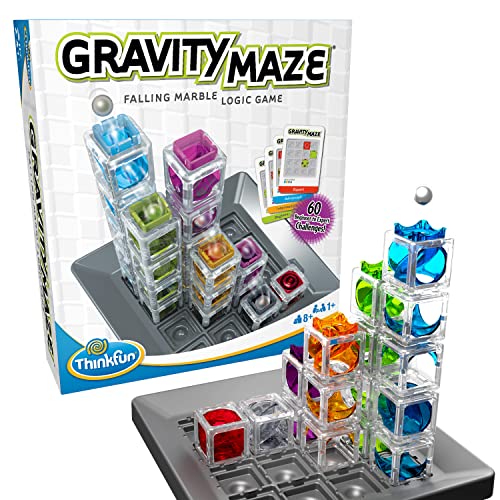
Gravity Maze Marble Logic Game
Editor’s pick · ThinkFun

Gravity Maze Marble Logic Game

If you buy one thing on this list, make it this. A challenge card shows where the marble starts and where it has to land, and the eight-year-old has to build a working tower of clear chutes to connect them — then drop the marble and watch whether their plan actually holds. It's a single-player logic game with sixty graded challenges, so it scales from "oh, that's easy" to genuinely head-scratching, and there's a real payoff at the end of each one: the marble either makes it or it doesn't. That instant, honest feedback is exactly what keeps a kid this age coming back instead of wandering off.

Builds: planning · spatial reasoning · persistence

~$20· See it on Amazon
Rush Hour Traffic Jam Logic Game
Best logic classic · ThinkFun

Rush Hour Traffic Jam Logic Game

The sliding-car puzzle that has earned its place in classrooms for decades. You have to nose your red car out of a gridlocked lot by sliding the other vehicles out of the way — but only forward and back, never sideways, which forces a child to think several moves ahead. The forty included challenge cards run from beginner to expert, so an eight-year-old starts on the easy ones and works up over months, not one afternoon. It's compact, has no batteries, and is the rare brain-teaser that travels well in a bag.

Builds: sequential reasoning · planning ahead · focus

~$22· See it on Amazon
Kanoodle 3D Brain-Teaser Puzzle
Best travel puzzle · Educational Insights

Kanoodle 3D Brain-Teaser Puzzle

The pocket-sized puzzle that punches absurdly above its price. A puzzle book sets up the board with a few pieces placed, and the child has to fit the rest of the knobby plastic shapes into the grid — there's exactly one solution, and finding it is deeply satisfying. With two hundred challenges, it's the thing that keeps an eight-year-old quietly absorbed on a flight, in a waiting room, or in the car. It snaps shut into its own case so pieces don't scatter, which is half the battle with travel toys.

Builds: spatial reasoning · trial & error · patience

~$11· See it on Amazon

Build it & make it go

The sweet spot at this age is a project with a payoff: engineer something, then send the marble or car or robot and find out if your plan worked. The fix-it loop when it doesn't is where the thinking happens.

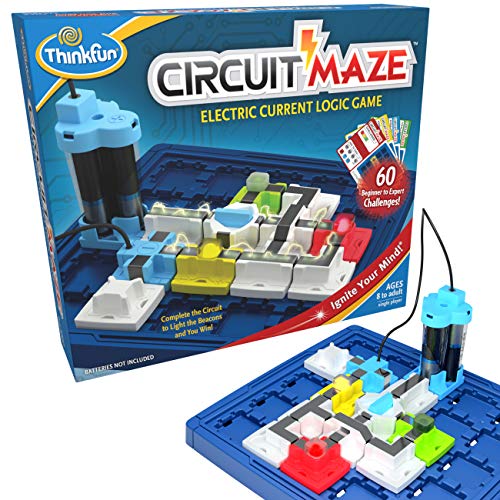
Circuit Maze Electric Logic Game
Best STEM · ThinkFun

Circuit Maze Electric Logic Game

Toy of the Year finalist

Real circuitry disguised as a puzzle. A child places the beacons and tokens a challenge card asks for, then has to route a working circuit so the right lights actually glow — get the path wrong and nothing lights up, which is the whole lesson. It introduces conductors, switches, and parallel paths without a single worksheet, and the "did it light?" moment is the kind of immediate feedback eight-year-olds live for. Sixty challenges across four difficulty levels mean it grows with them well past this birthday.

Builds: circuit logic · deductive reasoning · problem solving

~$30· See it on Amazon
Roller Coaster Challenge Building Game
Best engineering · ThinkFun

Roller Coaster Challenge Building Game

TOTY Game of the Year finalist

Part logic puzzle, part build-it-yourself roller coaster. Each of the forty challenge cards adds constraints — posts here, track there — and the child has to engineer a coaster that gets the car all the way to the bottom without flying off or stalling. The "send the car down and see if it works" test at the end is the hook, and the fix-it loop when it doesn't is where the real engineering thinking happens. It demands more focus than a quick game, which makes it a great rainy-afternoon project for a kid ready to sit with something harder.

Builds: engineering · following plans · spatial reasoning

~$38· See it on Amazon
Artie 3000 The Coding Robot
Best coding · Educational Insights

Artie 3000 The Coding Robot

A drawing robot a child programs to make art — and one of the gentlest real on-ramps to coding at this age. Kids drag-and-drop blocks (or type commands as they grow) to steer Artie around the paper, and the robot draws exactly the path they coded, mistakes and all. That tight loop between "I wrote this instruction" and "the robot did this" is the single best way an eight-year-old internalizes what code actually is. It connects over its own Wi-Fi to a tablet or computer, so no app-store hunting, and the worst-case outcome is a wonky spiral — which kids find hilarious, not discouraging.

Builds: coding logic · sequencing · cause & effect

~$39· See it on Amazon

Real science & discovery

Eight-year-olds want the real thing, not a toy version. A working microscope and a fizzing reaction turn curiosity into a Saturday.

National Geographic Junior Microscope Kit
Best science · National Geographic

National Geographic Junior Microscope Kit

The toy that turns "everything is interesting under here" into a Saturday. This kid-friendly scope magnifies up to 250x and comes with prepared slides plus a guide, so an eight-year-old can go from pond water to onion skin to their own hair in an afternoon. Real magnification at this age does something a screen can't — it makes the ordinary world suddenly strange and worth looking at closely. It takes a little grown-up help to focus the first few times, after which most kids run with it.

Builds: observation · scientific curiosity · careful handling

~$33· See it on Amazon
KidzLabs Volcano Making Kit
Best under $15 · 4M

KidzLabs Volcano Making Kit

The classic erupting-volcano experiment, and a perfect first taste of "I made a reaction happen." The child casts and paints the volcano, then sets off the fizzing eruption with baking soda and vinegar — the wait-and-watch payoff that hooks kids on science. It's a project with a satisfying arc: build it, decorate it, then make it go. Be ready for a little mess (that's the fun), and know it's more a few-sessions activity than a forever toy — but for the price it earns its keep.

Builds: following steps · cause & effect · patience

~$14· See it on Amazon

School-smart & hands-on

Learning lands best when it's concrete and a little competitive — and sometimes the best gift is a quieter, make-it-yourself project.

Fraction Formula Math Game
Best math · Educational Insights

Fraction Formula Math Game

Fractions you can actually see and stack. Players draw cards and drop matching fraction tiles into a clear cylinder, racing to get as close to a whole as possible without going over — so a third-grader feels in their hands that two quarters and a half make a whole. It's the rare math game that makes an abstract, often-dreaded topic concrete and a little bit competitive, which is exactly how fractions click. Genuinely useful right when fractions hit the curriculum, and fun enough that kids don't clock it as homework.

Builds: fractions · number sense · quick estimation

~$21· See it on Amazon
Created by Me! No-Sew Butterfly Fleece Quilt
Best craft · Melissa & Doug

Created by Me! No-Sew Butterfly Fleece Quilt

A real, keep-it-forever craft an eight-year-old can mostly do alone. You knot fleece squares together — no needle, no glue, no batteries — to build up a genuine four-by-five-foot quilt, and the finished blanket is something a kid is honestly proud to have made and then use. It's a longer project that rewards patience and a sense of process, and it's a welcome change of pace from the logic-and-science end of this list. The repetitive knotting is also quietly good for hands and focus.

Builds: fine motor · following a process · pride of making

~$28· See it on Amazon

How much to spend

You really don't need to spend much. Several of the best toys here are under $25 — the 4M Volcano kit, Kanoodle, Rush Hour, Gravity Maze, and Fraction Formula all punch above their price. The $28–39 range (Circuit Maze, the microscope, Roller Coaster Challenge, the Artie coding robot) is where most generous birthday gifts land — and at eight there's genuinely no need to go higher than that to get something excellent and long-lasting.

Frequently asked questions

What are the best educational toys for an 8-year-old?
Our top pick is ThinkFun’s Gravity Maze — a marble logic game with sixty graded challenges that grows with a child for years. For range, mix a few types: a logic game (Gravity Maze or Rush Hour), a build-and-test STEM toy (Circuit Maze or Roller Coaster Challenge), a real science tool (a junior microscope), and a coding on-ramp (Artie 3000). Every toy in this guide comes from an established maker like ThinkFun, Educational Insights, National Geographic, or Melissa & Doug.
How much should I spend on a gift for an 8-year-old?
You do not need to spend much. Some of the best toys for this age are under $25 — the 4M Volcano kit, Kanoodle, Rush Hour, Gravity Maze, and Fraction Formula all punch far above their price. A $30–40 toy like Circuit Maze, the Roller Coaster Challenge, or the Artie 3000 coding robot makes a generous birthday gift. There is no need to spend more than that to get something genuinely good and long-lasting at eight.
What kinds of toys are best for an 8-year-old’s development?
Toys that make the child do the thinking, not toys that perform for them. Single-player logic games (Gravity Maze, Rush Hour, Kanoodle) build planning and persistence; build-and-test sets (Circuit Maze, Roller Coaster Challenge) teach engineering through trial and error; a coding robot makes the link between an instruction and a result concrete; and real tools like a microscope feed genuine curiosity. As a rule, the more a toy lights up and plays itself, the less your child is actually doing.
Are logic and brain-teaser games actually good for kids this age?
Yes — eight is close to ideal for them. By this age most kids can hold several steps in mind and plan a sequence, which is exactly what games like Rush Hour and Gravity Maze demand. The single-player format means no waiting on a sibling and no losing-to-a-grown-up frustration, and the graded challenge cards let a child start easy and work up at their own pace. The honest pass-or-fail feedback — the marble makes it or it doesn’t — is what keeps them engaged.
What’s a good first coding toy for an 8-year-old?
A robot that does something visible when you program it. The Artie 3000 is a strong pick: a child arranges drag-and-drop blocks to steer it, and the robot draws exactly the path they coded — so the connection between "the instruction I wrote" and "what happened" is immediate and concrete. Screen-free or screen-light coding toys like this teach sequencing and cause-and-effect, the real foundations of coding, without committing a young child to a screen for hours.

How we choose — and a word on the links

Educational Toys Planet has specialized in learning toys since 2004. We pick independently, only from established makers, then cross-check every candidate against current availability and the major independent award and expert lists. We don't accept payment for placement.

Affiliate disclosure: the product links here are Amazon Associate links. If you buy through them we may earn a small commission at no extra cost to you — that's what keeps these guides free and updated. Prices change; tap through for Amazon's current figure. Last updated June 2026.

Related guides