Best Cognitive Development Toys & Activities for Kids (2026)

The best "brain" toys make the child do the thinking. Cognitive development isn't a subject you can buy — it's the underlying machinery of reasoning, memory, planning, and spatial sense that gets built through the right kind of play. The trap is the toy aisle's version: blinking plastic that quizzes a child and calls it learning. The toys that actually move the needle are quieter, and usually hand the kid a problem instead of an answer.

So we kept only toys we'd give a child to think with — every one from a maker with a real track record, spanning toddler memory games to grade-school logic puzzles, with a genuine reason behind each choice.

🧸 Curating learning toys since 2004 Independent picks · no pay-for-placement

The cognitive skills worth building — and the toys that build them

"Cognitive development" sounds abstract until you break it into the handful of skills kids are actually practicing. Logical reasoning and planning — thinking several moves ahead, undoing a wrong assumption — is what single-player puzzles like Rush Hour and Balance Beans drill. Spatial reasoning, picturing how things fit and move in three dimensions, gets built by Gravity Maze and open-ended gears. Working memory and attention start with simple matching games and grow from there. And pattern recognition and number sense are the early-math skills that a patterning board or a dice game quietly lays down.

The common thread in everything below: the toy gives feedback, but the child supplies the thinking. A marble lands on the target or it doesn't; a balance tips or holds; a gear train spins or stalls. That self-correcting loop is what turns play into genuine problem-solving — and it's exactly what a worksheet or a talking toy can't replicate. The more a toy performs on its own, the less your child is actually doing.

Logic & problem-solving

The heart of cognitive development: toys that make a child plan ahead, test an idea, and reason their way out. Single-player by design, so they build genuine independent focus.

Rush Hour Junior Traffic Jam Logic Game
Editor’s pick · ThinkFun

Rush Hour Junior Traffic Jam Logic Game

If you buy one cognitive-skills toy, make it a Rush Hour. The premise is dead simple — slide the cars and trucks so the ice-cream truck can escape the gridlock — but solving it means thinking several moves ahead and undoing your own assumptions, which is exactly the planning muscle a young brain is building. The Junior edition dials the difficulty down to a five- or six-year-old's reach with 40 stacked challenge cards, so wins come fast and then get genuinely hard. It's single-player, self-contained, and travels well, so it buys real quiet focus.

Builds: sequential planning · logical reasoning · spatial awareness

~$23· See it on Amazon
Rush Hour Traffic Jam Logic Game
Best for ages 8+ · ThinkFun

Rush Hour Traffic Jam Logic Game

The original — and once a kid has outgrown the Junior version, this is where they graduate. Same brilliant slide-the-cars premise, but the 40 challenge cards run all the way to "expert" and will stump adults too. It's the gold standard for sequential-planning puzzles: every move has consequences, and brute force fails fast, so kids learn to think the whole sequence through before touching a piece. Compact, endlessly replayable, and the reason ThinkFun built a whole reputation.

Builds: sequential planning · logical reasoning · spatial awareness

~$22· See it on Amazon
Kanoodle 3D Brain Teaser Puzzle Game
Best solo brain teaser · Educational Insights

Kanoodle 3D Brain Teaser Puzzle Game

The pocket-sized brain teaser that quietly eats car rides and waiting rooms. Kids fit the linked beads into the tray so every space is filled — easy to start, devious to finish, with 200 challenges that ramp from "oh, got it" to "okay, how." It's pure spatial problem-solving with no batteries, no pieces to lose, and a clip-shut case. The reason it's a perennial: a child can play it entirely alone and stays genuinely stuck-then-satisfied, which is the whole point.

Builds: working memory · spatial reasoning · persistence

~$11· See it on Amazon
Balance Beans Math Logic Game
Best logical reasoning · ThinkFun

Balance Beans Math Logic Game

Pre-algebra that feels nothing like algebra. Kids place red beans on a balance to match the puzzle card, and the seesaw either tips or holds — instant, physical feedback on whether their reasoning was right. The 40 single-player challenges sneak in the logic of equations (this side must equal that side) years before a worksheet would. It's quietly one of the best early-reasoning toys out there, and a kid can run it solo without a grown-up refereeing.

Builds: logical reasoning · critical thinking · early algebra

~$20· See it on Amazon
Dog Crimes Logic & Deduction Game
Best deduction puzzle · ThinkFun

Dog Crimes Logic & Deduction Game

A logic-grid mystery a kid actually wants to solve. Which of six guilty-looking dogs chewed the shoe? The clue cards rule suspects in and out, and the only way through is careful elimination — "if Rex is on the left, then…" — which is deduction in its purest, most playful form. The 40 challenges climb steeply, the artwork is funny, and it's single-player, so it's a reliable independent-thinking session for an eight-year-old.

Builds: deductive reasoning · logical elimination · focus

~$15· See it on Amazon

Spatial reasoning & building

Thinking in three dimensions — picturing how pieces fit and move before you commit. The spatial sense these build underpins everything from geometry to engineering.

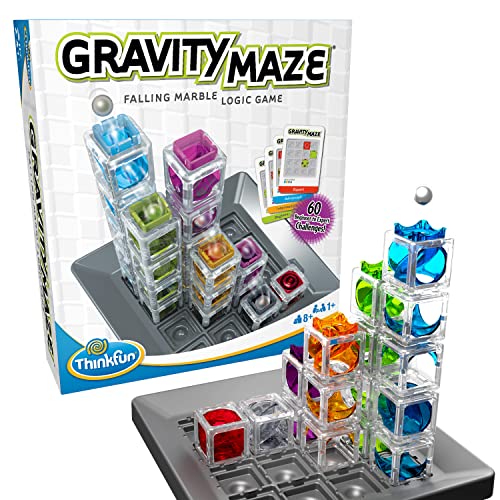
Gravity Maze Falling Marble Logic Game
Best spatial reasoning · ThinkFun

Gravity Maze Falling Marble Logic Game

Part logic puzzle, part marble run — and the rare STEM toy where the thinking is the fun. You place clear towers so a dropped marble threads through them and lands on the target, which forces a kid to picture the path in three dimensions before they ever release the ball. The 60 challenge cards climb from gentle to seriously brain-bending, so it grows with a child across years rather than getting solved in a weekend. It's our pick for the kid who likes building but needs a reason to think first.

Builds: spatial reasoning · planning ahead · problem solving

~$20· See it on Amazon
Roller Coaster Challenge STEM Building Game
Best build-and-solve · ThinkFun

Roller Coaster Challenge STEM Building Game

A logic game disguised as the coolest toy in the room. Each of the 40 challenge cards shows where posts and track must start and end, and the child has to engineer a working roller coaster that obeys the constraints — then send a car down to prove it. It's planning, trial-and-error, and spatial reasoning rolled into something a six-year-old genuinely wants to keep doing. A TOTY Game of the Year finalist, and one of the few builders where finishing actually does something.

Builds: planning · spatial reasoning · persistence

~$38· See it on Amazon
Gears! Gears! Gears! 100-Piece Deluxe Building Set
Best for ages 3-5 · Learning Resources

Gears! Gears! Gears! 100-Piece Deluxe Building Set

The youngest end of cognitive play is all about cause and effect, and nothing teaches it more directly than a sprawl of interlocking gears that actually turns. A preschooler snaps them together, gives the crank a spin, and watches the whole contraption come alive — the seed of "if I change this, that changes." It's open-ended in a way worksheets only pretend to be, and chunky enough for three-year-old hands. One honest note: gears that don't quite mesh won't spin, so a little grown-up coaching early on turns a stall into a puzzle.

Builds: cause & effect · fine motor · early engineering

~$22· See it on Amazon

Early reasoning for little ones

Cognitive skills start younger than most "brain" toys allow. Patterning, memory, and number sense, sized for toddlers and preschoolers who learn by holding, not memorizing.

Pattern & Sequencing Wooden Board
Best for preschool patterning · Educational Insights

Pattern & Sequencing Wooden Board

Recognizing and extending a pattern is one of the earliest reasoning skills, and the bridge to early math. Kids slot wooden pegs to copy and then continue the sequences on the activity cards — a concrete, hands-on version of "what comes next" that's far stickier than a worksheet. The Montessori-style wooden pieces are sized right for small hands and double as a fine-motor workout. A calm, focused table toy for a three- or four-year-old.

Builds: pattern recognition · sequencing · fine motor

~$22· See it on Amazon
My First Game: Bears in Pairs
Best memory game for toddlers · Educational Insights

My First Game: Bears in Pairs

Memory and attention are cognitive skills too, and this is where they start. Toddlers hunt for matching bear pairs hidden under the cups — a first memory game built for two-year-old patience, with chunky pieces and rounds short enough to finish before focus fades. It's also a gentle first lesson in taking turns and waiting, which is its own kind of brain work at this age. A genuinely two-year-old-appropriate pick in a category full of toys that are secretly too hard.

Builds: working memory · attention · turn-taking

~$25· See it on Amazon
Math Dice Junior Game
Best under $12 · ThinkFun

Math Dice Junior Game

A tiny tin that builds genuine mental agility. Roll the dice, then combine the numbers with +, −, and the included moves to race your token along the track — there's always more than one path to the answer, which is the part that grows flexible thinking. It keeps a six-year-old doing arithmetic for fun, and scales naturally as they get quicker. Cheap, pocketable, and a Toy of the Year nominee for good reason.

Builds: mental math · working memory · flexible thinking

~$11· See it on Amazon

How much to spend

You really don't need to spend much. Several of the best picks here are around $11Kanoodle and Math Dice Junior both punch far above their price. The $20–25 sweet spot (Rush Hour Junior, Gravity Maze, Balance Beans, Gears!) is where most generous gifts land — and one good logic game outlasts a shelf of cheaper toys. The one splurge worth it is the Roller Coaster Challenge at around $38, which has years of escalating play in the box.

Frequently asked questions

What are the best toys for cognitive development?
Toys that make a child do the thinking, not toys that perform for them. Our top pick is ThinkFun Rush Hour Junior — a single-player logic game that builds sequential planning and reasoning. For a complete cognitive workout, mix the domains: a logic puzzle (Rush Hour or Balance Beans), a spatial-reasoning game (Gravity Maze), a memory game (Bears in Pairs for toddlers), and an early-pattern or number toy. Every toy in this guide comes from an established maker like ThinkFun, Learning Resources, or Educational Insights.
What is the difference between cognitive and STEM toys?
They overlap, but the emphasis differs. STEM toys teach a domain — circuits, gears, chemistry. Cognitive-development toys train underlying thinking skills that apply everywhere: logical reasoning, working memory, spatial visualization, pattern recognition, and planning. A marble-maze logic game like Gravity Maze is both — it teaches spatial reasoning (cognitive) through a physics-flavored build (STEM). When in doubt, ask whether the toy is building a skill or teaching a subject; the best ones do both.
At what age should I start cognitive-skills toys?
Earlier than the "brain teaser" aisle suggests. Cause-and-effect toys like Gears! Gears! Gears! and first memory games like Bears in Pairs work from age 2 to 3. Patterning and sequencing boards land around 3 to 4. Structured single-player logic games — Rush Hour Junior, Balance Beans — are a fit at 5 to 6, and the harder deduction and marble-maze games (Dog Crimes, Gravity Maze, the original Rush Hour) shine from 8 up. Match the toy to where your child is, not just their birthday.
Are single-player logic games actually good for kids?
They are some of the best cognitive tools you can buy. A solo puzzle like Rush Hour, Kanoodle, or Balance Beans lets a child get genuinely stuck and then work through it without a grown-up refereeing — which is exactly how problem-solving and persistence get built. The self-correcting feedback (the marble lands or it doesn’t; the balance tips or holds) means kids learn from the toy itself. They also buy real, screen-free independent focus, which is increasingly rare.
How much should I spend on a cognitive-development toy?
Not much. Several of the best here are around $11 — Kanoodle and Math Dice Junior both punch far above their price. The $20–25 sweet spot (Rush Hour Junior, Gravity Maze, Balance Beans, Gears! Gears! Gears!) is where most generous gifts land, and a single one of these will outlast a shelf of cheaper toys. The one splurge worth it is the Roller Coaster Challenge at around $38 — it has years of escalating play in the box.

How we choose — and a word on the links

Educational Toys Planet has specialized in learning toys since 2004. We pick independently, only from established makers, then cross-check every candidate against current availability and the major independent award and expert lists. We don't accept payment for placement.

Affiliate disclosure: the product links here are Amazon Associate links. If you buy through them we may earn a small commission at no extra cost to you — that's what keeps these guides free and updated. Prices change; tap through for Amazon's current figure. Last updated June 2026.

Related guides