

Best Award-Winning Developmental Toys for Kids (2026)

“Award-winning” should mean something. This category is flooded with blinking plastic that calls itself educational and does the playing for the child. The toys worth giving are the opposite: open-ended, a little demanding, and built well enough to survive years of real use — the kind that turn up again and again on the independent award and expert lists.

So we kept only toys we'd actually give a kid — every one from a maker with a real track record, cross-checked against the major award programs, with a genuine, honest reason behind each pick. Ages roughly 3 to 12.

🧸 Curating learning toys since 2004 Independent picks · no pay-for-placement

What actually makes a toy “developmental”

The useful test isn't the label on the box — it's how much of the work the child does versus the toy. A truly developmental toy hands a kid a problem and gets out of the way: an open-ended building set with no single right answer, a logic puzzle that demands a plan, a coding robot that has to be debugged when it bonks the wall. The learning is a by-product of the play, not a lecture bolted onto it.

Independent awards — Oppenheim, NAPPA, Parents' Choice, ASTRA's Best Toys for Kids — are a handy filter because the judges put toys in front of real children before they hand out a badge. We treat a strong award record as a signal, not a guarantee, and still cross-check every pick for current availability and honest value. The result is a short list that skews toward the makers who keep showing up: ThinkFun, Learning Resources, Educational Insights, Magna-Tiles, and Fat Brain Toys.

Open-ended builders

The toys that win the most awards tend to be the ones with no "right" answer — open-ended sets a child returns to for years because the play keeps changing as they grow.

Magna-Tiles Classic 32-Piece Set
Editor’s pick · Magna-Tiles

Magna-Tiles Classic 32-Piece Set

If we could keep only one toy on this whole list, it'd be this. Magna-Tiles is the rare set that turns up on nearly every serious award and expert list and still earns its place in real living rooms — a three-year-old lays flat mosaics, a six-year-old builds garages and marble runs, and nobody outgrows it for years. The magic is in the magnets: genuine tiles hold firmly enough that a tower actually stays up, which is the difference between absorbed play and a meltdown. The real ones cost more than the lookalikes, and they're worth every dollar — the cheap magnets give up fast.

Builds: spatial reasoning · early geometry · fine motor

~$40· See it on Amazon
Mini Squigz Suction Construction Set
Best sensory build · Fat Brain Toys

Mini Squigz Suction Construction Set

A building toy that sticks to the bathtub wall, the window, the fridge, and itself. Squigz are soft silicone suction cups that pop together with a satisfying snap, so kids build wobbly creatures and chains that flex and bounce instead of standing rigid — a completely different kind of construction from blocks. The pressing-and-pulling is a genuine hand-strength workout, the material is dishwasher-safe and indestructible, and the "Mini" set is the right size for small hands and travel. It's one of those toys grown-ups end up fidgeting with too.

Builds: fine motor · hand strength · creativity

~$25· See it on Amazon
Design & Drill Activity Center
Best tinkering toy · Educational Insights

Design & Drill Activity Center

A real, kid-safe power drill — and that's the entire appeal. Kids drive colorful bolts into a board to match pattern cards or invent their own designs, building genuine fine-motor strength and a first taste of "I made the tool do the work." The reversible drill (and the delight of un-drilling everything to start over) buys a remarkable amount of independent, focused play. It buzzes, so it isn't a silent toy — but that little motor is exactly what they'll love, and it's been a preschool-shelf staple for good reason.

Builds: fine motor · hand strength · patterns

~$31· See it on Amazon

Early learning, disguised as play

Reading, first coding, and early math land best when they're concrete and a little bit fun. No flashcards here — just toys that sneak the learning in.

Zingo Word Builder
Best early reading · ThinkFun

Zingo Word Builder

The reading version of the Zingo kids already love. The Zinger slider dispenses letter tiles with a clack children adore, and they race to build simple words on their cards — phonics and spelling sneaking in under the cover of a fast, genuinely fun game. It's our pick for the new-reader years because the pace is quick enough to hold short attention spans and the difficulty scales as they grow. Turn-taking and a little friendly competition make it a family-table favorite, not a worksheet in disguise.

Builds: early literacy · spelling · turn-taking

~$23· See it on Amazon
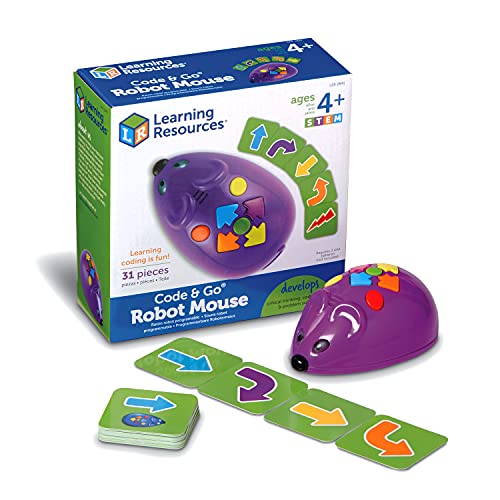
Code & Go Robot Mouse
Best first coding · Learning Resources

Code & Go Robot Mouse

Coding with no screen at all — exactly what a four- or five-year-old needs first. Kids build a maze with the included walls, then press direction buttons to program Colby the mouse to reach the cheese. When he bonks a wall, they have to debug the sequence and try again, which is the whole heart of programming taught with a giggling plastic mouse. It's the gentlest, most concrete on-ramp to algorithmic thinking we know, and it grows into harder challenges as kids get the hang of planning several steps ahead.

Builds: sequencing · logical thinking · problem solving

~$32· See it on Amazon
Balance Beans Math Game
Best early math · ThinkFun

Balance Beans Math Game

Pre-algebra a five-year-old can feel in their fingers. Kids place red beans on a seesaw to make it balance, working through 40 challenge cards that ramp from obvious to genuinely tricky — and without ever using a number, they're internalizing the idea that two sides of an equation have to match. It's a quiet single-player puzzle, great for independent focus, and it does something most "math toys" don't: it makes abstract balance concrete and tactile, the way early math actually clicks.

Builds: pre-algebra · logical reasoning · spatial sense

~$20· See it on Amazon

STEM & engineering challenges

For the kid who likes building toward a goal: each of these gives a problem to solve and a satisfying, physical payoff when the marble runs or the coaster works.

Roller Coaster Challenge
Best engineering · ThinkFun

Roller Coaster Challenge

Build a working roller coaster, then watch the marble car actually fly down it. Each of the 40 challenge cards tells kids where the posts and track must go; they have to figure out the rest so the car completes the loop without flying off. It's part logic puzzle, part construction toy, and the payoff — a coaster that runs — is the kind of concrete reward that keeps a six-to-ten-year-old coming back. A favorite for the kid who likes building with a goal rather than open-ended free play.

Builds: engineering · logical reasoning · planning

~$38· See it on Amazon
Artie 3000 The Coding Robot
Best screen-coding · Educational Insights

Artie 3000 The Coding Robot

A robot that draws whatever you code. Kids program Artie from a tablet or computer — drag-and-drop blocks for beginners, real JavaScript and Python for older ones — and he rolls across the paper sketching the result with a marker. The instant, visible feedback (a wonky circle means your angles were off) makes the link between code and outcome obvious, and the leap from block coding to typed languages means it lasts well past the first year. The honest caveat: it needs a device to drive it, so it's a screen-adjacent toy, not a screen-free one.

Builds: coding · geometry · creativity

~$39· See it on Amazon

Logic & problem-solving

Single-player brain-teasers that reward patience and planning — perfect for independent quiet time, and genuinely hard enough to keep an adult honest.

Rush Hour Traffic Jam Logic Game
Best logic game · ThinkFun

Rush Hour Traffic Jam Logic Game

The sliding-car puzzle that's been hooking kids and adults for decades. You slide blocking cars and trucks out of the way to free the red car off the grid — simple to grasp, and the 40 challenge cards climb from "warm-up" to "you'll be stuck for ten minutes." It's a single-player game, so it's perfect for independent quiet time, and it teaches sequential planning and "if I move this, then that" reasoning better than almost anything at this price. One of the most awarded logic games ever made, and it travels well.

Builds: logical reasoning · planning · spatial thinking

~$22· See it on Amazon
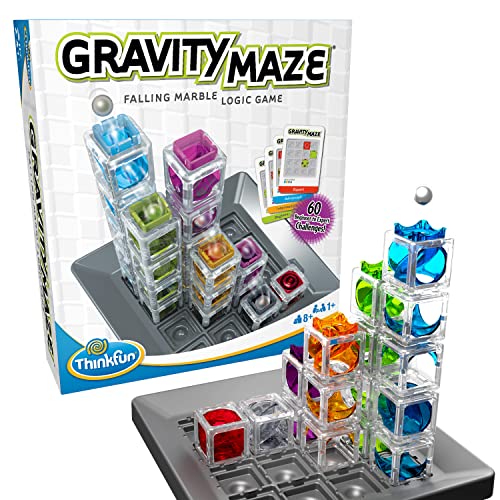
Gravity Maze Marble Logic Game
Best STEM puzzle · ThinkFun

Gravity Maze Marble Logic Game

A marble run and a brain-teaser fused into one. Kids study a challenge card, then place the clear towers so a dropped marble actually finds its way to the target — which means they have to picture the path in three dimensions before they ever release the ball. It starts genuinely easy and ends genuinely hard (the last cards stump grown-ups), so it has a long runway, and the satisfying clatter of a marble completing the run is its own reward. The gold standard for spatial-reasoning toys in the eight-and-up range.

Builds: spatial reasoning · planning · logical thinking

~$20· See it on Amazon
Botley 2.0 The Coding Robot Set
Best coding robot · Learning Resources

Botley 2.0 The Coding Robot Set

The screen-free coding robot that grows with the kid. Botley takes commands from a remote — no tablet, no app — so a five-year-old programs him to navigate obstacle courses, follow black-line tracks, and even detect objects, all through real sequences and loops. It's our pick for families who want coding without another screen, and the activity set comes with enough pieces to keep the challenges fresh for a long while. The remote-and-robot setup makes the abstract idea of "a program" something kids can watch roll across the floor.

Builds: coding · sequencing · problem solving

~$59· See it on Amazon

How much to spend

You really don't need to spend much for a great developmental toy. Several of the best here are under $25Gravity Maze, Rush Hour, Balance Beans, and the Mini Squigz set all punch far above their price. The $30–40 range (Code & Go Robot Mouse, Design & Drill, Roller Coaster Challenge, Artie 3000) is where most generous birthday gifts land. And the splurges worth it — a larger Magna-Tiles set or the Botley activity kit — last so many years the cost-per-play is tiny.

Frequently asked questions

What makes a toy “award-winning” — and does it actually matter?
Independent award programs like the Oppenheim Toy Portfolio, NAPPA, Parents’ Choice, and ASTRA’s Best Toys for Kids put toys through hands-on testing with real children and judges, then recognize the standouts. It matters because those badges are a useful filter against the blinking-plastic junk that floods this category: a toy that wins across several independent programs has usually proven it holds a child’s attention and teaches something real. We don’t pick on badges alone, but a strong award record is a good signal you’re looking at a genuine toy, not marketing.
What are the best award-winning developmental toys overall?
Our top pick is Magna-Tiles — open-ended magnetic building that turns up on nearly every expert and award list and grows with a child for years. For range, mix the types of play: an open-ended builder (Magna-Tiles or Squigz), a screen-free coding toy (Code & Go Robot Mouse or Botley), an early-math or reading game (Balance Beans, Zingo Word Builder), and a logic puzzle (Rush Hour or Gravity Maze). Every toy here comes from an established maker like ThinkFun, Learning Resources, Educational Insights, or Fat Brain Toys.
Which of these toys are best for STEM?
For hands-on STEM, the standouts are ThinkFun’s logic line — Gravity Maze and Rush Hour for spatial reasoning, Balance Beans for pre-algebra, and Roller Coaster Challenge for engineering. For coding specifically, the Code & Go Robot Mouse and Botley 2.0 teach sequencing and debugging with no screen at all, while Artie 3000 bridges into real block-and-text programming. They cover the full span from preschool problem-solving to upper-elementary code.
How much should I spend on a good developmental toy?
You don’t need to spend much. Several of the best toys here are under $25 — Gravity Maze, Rush Hour, Balance Beans, and the Mini Squigz set all punch far above their price. The $30–40 range (Code & Go Robot Mouse, Design & Drill, Roller Coaster Challenge, Artie 3000) is where most generous birthday gifts land. Save a $40–60 pick like a larger Magna-Tiles set or the Botley activity kit for a milestone — these last for years, so the cost-per-play ends up tiny.
What age are these toys for?
This guide spans roughly ages 3 to 12. The open-ended builders (Magna-Tiles, Squigz, Design & Drill) start at 3; first-coding and early-learning toys (Code & Go Robot Mouse, Zingo Word Builder, Balance Beans, Botley) suit 4–6; and the tougher logic and engineering picks (Roller Coaster Challenge, Rush Hour, Gravity Maze, Artie 3000) are best from about 6 to 12. Each pick notes its sweet spot — match the toy to where your child is now, since the best ones stretch a year or two past that anyway.

How we choose — and a word on the links

Educational Toys Planet has specialized in learning toys since 2004. We pick independently, only from established makers, then cross-check every candidate against current availability and the major independent award and expert lists. We don't accept payment for placement.

Affiliate disclosure: the product links here are Amazon Associate links. If you buy through them we may earn a small commission at no extra cost to you — that's what keeps these guides free and updated. Prices change; tap through for Amazon's current figure. Last updated June 2026.

Related guides