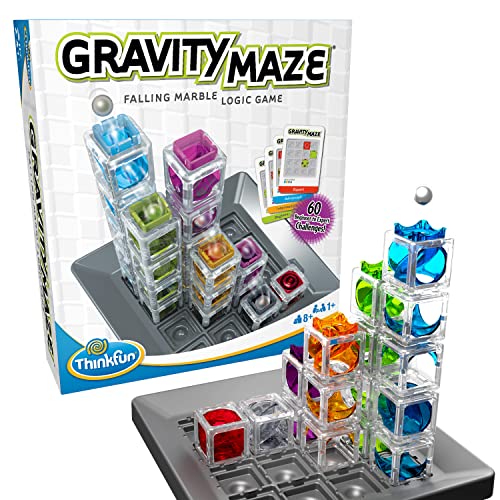
A marble run is a physics lab disguised as a toy. A child stacks a tower, drops a
marble, watches it stall on a too-flat ramp — and rebuilds. That loop of build, test, fix is
the real lesson, and it's why a good marble run holds up where a lot of "STEM" toys quietly gather dust.
We kept only sets we'd actually give a kid — every one from a maker with a real track record, sorted
by what it's best at and the age it truly fits, with an honest reason behind each pick.
Below: ten sets from a toddler's first wooden run to a 3-D logic puzzle for eight-year-olds, plus the
physics each one teaches, an age-by-age chart, and the frustrations worth designing around before you buy.
🧸 Curating learning toys since 2004 Independent picks · no pay-for-placement
How to pick the right marble run
The two questions that sort the whole category: how old is the child, and
do you want them building or watching? Age first — most marble runs ship with small
marbles that are a choking hazard, so a child under three needs a dedicated preschool set with oversized
balls (or a different toy entirely). From four up, the world opens: wooden block sets for little hands,
clear-tube systems for kids who want to see the marble travel, and big open-ended kits for the
eight-year-old who wants to engineer something sprawling.
The build-versus-watch split matters just as much. Open-ended sets (Quercetti, the big National
Geographic kits) are pure construction — the child designs every run, which is where spatial reasoning
really grows, but it asks for patience. Motorized sets (Techno Gears) lift the marble back to the top
automatically, so the action never stops — instant gratification that hooks a reluctant builder. And
logic sets (ThinkFun Gravity Maze) hand the child a puzzle to solve instead of a blank canvas. None is
"better"; they suit different kids and different days.
What a marble run actually teaches
Strip away the marketing and a marble run is a first physics course you can hold in your hands. Four
real ideas show up every time a child builds one:
- Gravity and stored energy. Lifting a marble to the top of a tower stores energy in it; letting go turns that height into speed. Build the tower taller and the marble arrives faster — the child is feeling potential energy become kinetic energy long before anyone names it.
- Momentum and slope. Too flat a ramp and the marble stalls; too steep and it leaps off the rail. Between them sits a slope that carries just enough speed through the next turn, and finding it is trial-and-error physics a five-year-old can do with their hands.
- Cause and effect in a chain. A run is a sequence — this chute feeds that funnel feeds those dominoes. Move one piece and the whole outcome changes, which is about the clearest lesson in cause and effect a young child will meet all week.
- The engineering design loop. Plan, build, test, watch it fail, fix, test again. That cycle — not any single tower — is the real skill, and it is the same loop a working engineer runs. A marble run teaches it painlessly, because the "test" is a marble you get to drop.
That is why, for once, the "STEM" label on the box is earned: the learning is not bolted on, it is
the toy itself.
Which marble run fits which age
Marble runs climb a fairly predictable ladder — chunky and forgiving at the bottom, sprawling and
logic-heavy at the top. Here is where each pick in this guide hits its stride; a few, like GraviTrax
Junior and the wooden Quadrilla, deliberately stretch across it and grow with the child.
| Age | What they're ready for | Picks from this guide |
| 3–4 | Chunky wooden blocks and jumbo-marble preschool sets — short builds, big pieces, no small marbles to swallow. | Hape Race Track, Galt 30-piece, GraviTrax Junior |
| 5–7 | Clear-tube systems and open-ended kits they design and rebuild themselves; small marbles are fine with a tidy-up habit. | Quercetti, NatGeo Magnetic, Design & Drill, Techno Gears Catapult |
| 8 and up | Sprawling builds, internal track logic, motor mechanics, and puzzle challenges with a right answer. | NatGeo 150-piece, Quadrilla Cliffhanger, ThinkFun Gravity Maze |
A note on safety and noise
Two practical things no product page mentions. First, the marbles: nearly every set
here uses small glass or plastic balls that are unsafe for children under three who still put things in
their mouths — for that age, stick to a preschool set with jumbo marbles like
GraviTrax Junior.
Second, noise: plastic tube runs are genuinely loud on a hard floor, and motorized
sets hum. If that's a dealbreaker, a wooden set on a rug is dramatically quieter.
Wood, plastic, or magnetic — and why the ecosystem matters
The material sets the personality. Wood (Hape, Quadrilla) is heavier, quieter, and
prettier, and it runs the marble through open channels — lovely, but a fast marble can leave the
track. Plastic tube sets (Quercetti, the big National Geographic kits) let a child
watch the marble travel through clear tubing and snap together into taller, wilder builds for less
money, at the cost of rattle and lighter pieces. Magnetic runs (National
Geographic's 75-piece set) drop the tower altogether and build sideways on the fridge, which makes
gravity obvious and leaves nothing to topple.
The part almost no one weighs at gift time is compatibility — and it is the
difference between a toy that grows and a drawer of orphaned parts. Pieces from different brands do
not interlock, and marbles are sized to a specific track, so the smart move is to pick one system and
add to it. Two here are built to expand: every Quadrilla set clicks into every other
Quadrilla set, and GraviTrax Junior hands off to the full GraviTrax line around age
eight — so the tiles you buy at three are not wasted at nine. If you suspect a child will fall hard
for marble runs, starting inside a system that expands is the most economical call you can make.
Common frustrations, and how to dodge them
Most marble-run disappointment traces back to a handful of predictable problems. None is a
dealbreaker if you see it coming.
- Too many pieces at once. A giant kit tipped out in front of a four-year-old overwhelms more than it delights. Start with 30–80 pieces, not 200 — a child who finishes a build is a child who builds again, and every good system expands later.
- The tower keeps falling. Wobble usually means carpet underneath or blocks stacked off-center. Build on a hard, flat surface, keep the tower over its own footprint, and let a young child work up to height rather than starting there.
- The marble stalls or flies off. Both are slope problems — too flat and it stops, too steep and it launches. This is the lesson, not a defect; nudging a ramp until the marble runs clean is exactly the physics the toy exists to teach.
- Marbles vanish. They will, under couches and into vents. Favor a set with a storage bag, keep a cheap bag of matching replacements on hand, and count them back in at clean-up so a run is not ruined by three missing balls.
- Expansion parts that do not fit. Add-on packs are brand- and often line-specific, and many include track only, no marbles. Match the exact system, and check whether marbles are included, before buying more.
How much to spend
You don't need to overspend on a first set. The under-$25 picks —
the Galt 30-piece,
Techno Gears Catapult, and
ThinkFun Gravity Maze — are plenty to find out whether
your child loves marble runs at all. The $30–40 sweet spot
(Hape Race Track,
GraviTrax Junior,
Design & Drill Marble Maze) is where most gift-worthy
sets land. Save a $60+ splurge like the
Hape Quadrilla Cliffhanger or the
150-piece glowing set for the child who's already proven
they'll build for hours — those expand for years, so the cost-per-play stays tiny.
How we choose — and a word on the links
Educational Toys Planet has specialized in learning toys since 2004. We pick independently, only from
established makers, then cross-check every candidate against current availability and the major
independent award and expert lists. We don't accept payment for placement.
Affiliate disclosure: the product links here are Amazon Associate links. If you buy
through them we may earn a small commission at no extra cost to you — that's what keeps these guides
free and updated. Prices change; tap through for Amazon's current figure. Last updated June 2026.