Best Crystal Growing Kits for Kids (2026)

A crystal growing kit is the rare science gift that delivers a real "wow." A child mixes a solution, waits, and watches actual crystals take shape over a few days — chemistry they can see happening, ending in something genuinely beautiful they made themselves. It's hands-on science that doesn't feel like homework.

We kept only kits from makers with a real track record — National Geographic, 4M, Thames & Kosmos, Creativity for Kids, Klutz — and split them into the two things people mean by "crystal kit": the grow-your-own kind and the crack-open-a-geode kind. Every pick has an honest reason, including the parts that need a grown-up.

🧸 Curating learning toys since 2004 Independent picks · no pay-for-placement

Two kinds of crystal kit — which one to buy

"Crystal kit" actually covers two very different toys, and knowing which you want makes shopping easy. A grow-your-own kit is a small chemistry project: your child dissolves a powdered solution in hot water, sets it aside, and over several days watches real crystals form — sometimes on a light-up stand that turns them into a display piece. The payoff is delayed, and that's the point: the waiting teaches patience and gives a kid a reason to check on their experiment each morning.

A break-open geode kit is the opposite — instant gratification. The crystals are already inside real geodes; your child cracks them open (goggles on, always) to discover what nature formed. It's a treasure hunt, and no two geodes are alike. Many families end up with one of each. The one constant across both: the setup or the hammering wants an adult alongside, so budget a little of your own time, not just the gift.

Grow-your-own crystal kits

The classic version: mix a solution, wait a few days, and watch real crystals form. These are the ones to start with — pick by how many crystals you want and whether the light-up display is worth it.

Crystal Growing Kit (3 Colored Crystals + Light-Up Stand)
Editor’s pick · National Geographic

Crystal Growing Kit (3 Colored Crystals + Light-Up Stand)

If you're buying one crystal kit, this is the one we'd start with. You grow three genuinely vivid crystals over about a week, then set them on a battery-powered light-up base that makes them look like something from a museum case — which is the part that keeps a kid checking on them every morning. The instructions are clear enough that an eight-year-old can run most of it themselves, and the included learning book actually explains why crystals form instead of just telling you to add the powder. Two honest notes: the growing solution is hot-water work, so plan to supervise the setup, and crystals take days, not minutes — that wait is the whole lesson in patience.

Builds: chemistry basics · patience · observation

~$20· See it on Amazon
Mega Crystal Growing Kit (Grow 8 Crystals)
Best big set · National Geographic

Mega Crystal Growing Kit (Grow 8 Crystals)

The upgrade pick for the kid who's already obsessed, or for a gift that needs to feel like a real present. You grow up to eight crystals in different colors, with enough material to do it more than once, and the light-up display stand shows off the whole collection at the end. It costs more than the starter kit, and the extra is mostly more crystal-growing material plus the bigger display — worth it if you know crystals will land, but the single-crystal kit is the safer first buy if you're unsure.

Builds: chemistry basics · following a process · observation

~$40· See it on Amazon
7 Crystal Growing Science Kit with Display Cases
Best value · 4M

7 Crystal Growing Science Kit with Display Cases

4M has been making this style of no-frills science kit for years, and it shows in the price-to-payoff. You grow seven crystals and snap each into its own little display case, so the finished set looks like a tiny specimen collection a kid can line up on a shelf. There's no light-up gimmick here, which is exactly why it's cheaper — what you get is more crystals and solid instructions. A good pick if you want the science without paying for the LED base.

Builds: chemistry basics · sequencing · observation

~$19· See it on Amazon
Crystal Growing STEM Experiment Kit
Best deep dive · Thames & Kosmos

Crystal Growing STEM Experiment Kit

Thames & Kosmos makes the kit for the kid who wants to understand crystallization, not just watch it happen. Beyond growing a batch of crystals, the included experiments get into seed crystals, growing on a string, and making crystal geodes — and the manual reads like a proper science guide, with the chemistry explained at a level a curious ten-year-old can follow. It's pitched at 10+ for a reason: there are more steps and more waiting than the simpler kits. For a child who already likes science, it's the most genuinely educational option here.

Builds: real chemistry · experiment design · geology

~$29· See it on Amazon
Jumbo Glow-in-the-Dark Crystal Growing Kit
Fastest result · National Geographic

Jumbo Glow-in-the-Dark Crystal Growing Kit

The antidote to the "is it done yet?" problem. This kit grows one large crystal in a few days rather than a full week, and it glows in the dark once it's formed — a combination that wins over kids who'd lose interest waiting on a slower set. It's a single crystal, not a collection, so it's more of a one-and-done project than a hobby starter, but it's a low-cost, high-delight way to find out whether crystal-growing clicks for your child before you spend more.

Builds: chemistry basics · observation · patience

~$18· See it on Amazon

Break-open geode kits

A different thrill — cracking real geodes to find the crystals hidden inside. Every one is a surprise. All of these need goggles, a hammer, and a supervising grown-up, so think of them as a together activity.

Break Open 4 Geodes Science Kit
Best geode crack-open · National Geographic

Break Open 4 Geodes Science Kit

A different kind of crystal fun — and a great pairing with a grow-your-own kit. These are real geodes, and you crack each one open (goggles included, and yes, required) to discover the crystal pocket hidden inside. No two are the same, so there's a genuine treasure-hunt thrill the first time a kid splits one and sees the sparkle. The catch every parent should know: you're hammering rocks, so this is an outdoor, supervised, wrap-it-in-a-sock activity — messy in the best way. Four geodes makes it a tidy gift; the learning guide helps kids actually identify what they found.

Builds: geology · careful technique · discovery

~$20· See it on Amazon
10 Break-Open Crystal Geodes (Wow in the World)
Best under $15 · Thames & Kosmos

10 Break-Open Crystal Geodes (Wow in the World)

The best small money in this guide, and a strong pick for the younger end (6+). You get ten real geodes to crack open, plus goggles, a magnifying glass, and a display case to show off the best finds — tied to the Wow in the World kids' science podcast, which gives the activity a story kids may already know. Ten geodes means siblings can each do a few, or one kid can ration the fun across several afternoons. As with any geode kit, it's a hammer-and-supervision job, so it's an adult-alongside activity rather than a hand-it-over one.

Builds: geology · discovery · fine motor

~$11· See it on Amazon
Break Open 15 Premium Geodes Science Kit
Best for a group · National Geographic

Break Open 15 Premium Geodes Science Kit

Buy this one when you need geodes for a crowd — a birthday party, a classroom, a scout troop, or a rock-obsessed kid who'll happily crack them all winter. Fifteen premium geodes is a lot of discovery, and the kit comes with goggles, three display stands, and a detailed learning guide so the cracking turns into real talk about how the crystals got there. It's the priciest pick here, but per-geode it's a bargain, and a party of kids each opening their own is genuinely memorable. Plan the hammering as a supervised, protect-the-table affair.

Builds: geology · discovery · sharing

~$41· See it on Amazon

Beyond the basics

Crystal growing as part of something bigger — a craft keepsake, a whole earth-science lab, or a book-led project for a reader.

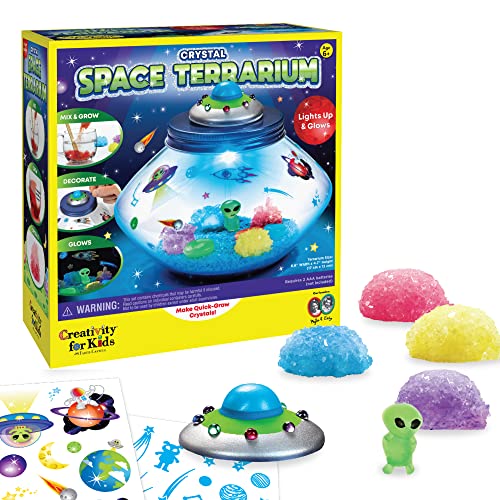
Crystal Space Terrarium Kit
Best craft crossover · Creativity for Kids

Crystal Space Terrarium Kit

The pick for the kid who loves making and decorating as much as science. You grow crystals inside a build-it-yourself space-themed terrarium, complete with figures and bits to arrange, so the finished thing is a keepsake scene rather than a lone crystal in a dish. Creativity for Kids leans craft-first, which is the appeal — it pulls in children who'd skip a pure chemistry kit. Rated 6+, so it's one of the more accessible options here, though the crystal-growing step still wants a grown-up for the hot water.

Builds: creativity · chemistry basics · fine motor

~$23· See it on Amazon
Earth Science Kit (100+ Experiments)
Best all-in-one · National Geographic

Earth Science Kit (100+ Experiments)

If crystals are really a way into a broader earth-science obsession, this is the box that feeds it. Crystal growing is just one of 100+ activities — there's also an erupting volcano, a dig for real gemstones, and a starter rock-and-mineral collection, all in one kit. It's the best value-per-activity here for a kid whose interests are still wide open, and it buys weeks of rainy-afternoon projects rather than a single session. The trade-off versus a dedicated crystal kit is that each individual activity is a bit simpler, but the variety more than makes up for it.

Builds: geology · chemistry basics · curiosity

~$30· See it on Amazon
Rocks, Gems and Geodes: Maker Lab
Best book + kit · Klutz

Rocks, Gems and Geodes: Maker Lab

Klutz does the rare thing of pairing a genuinely good book with the materials to do what it describes, and this one earns its place for the kid who likes to read about what they're making. It walks through growing crystals, making a geode, and a handful of other rock-and-mineral projects, with the clear, well-illustrated instructions Klutz is known for. It's less of a single dramatic result and more of a guided tour through earth science — ideal for a methodical reader, and it doubles as a reference they'll keep on the shelf afterward.

Builds: geology · reading · hands-on science

~$22· See it on Amazon

A word on safety and supervision

These are some of the most rewarding science gifts out there, but they aren't hand-it-over-and-walk-away toys. Grow-your-own kits use hot water to dissolve the crystal solution, so plan to run the setup step yourself; the crystal powders aren't for eating, and finished crystals are for display. Geode kits mean hammering rocks — always use the included goggles, work on a protected surface (a towel or an old cutting board), and ideally do it outdoors. Done with a grown-up alongside, both are safe, and the supervision is half the fun.

How much to spend

You can get a real crystal experience for very little. The under-$15 picks — the Wow in the World geodes and the Jumbo glow crystal — are perfect for a stocking stuffer or a first try. The $18–30 sweet spot (NatGeo color crystals, the 4M 7-crystal kit, Thames & Kosmos, the Earth Science kit) is where most birthday gifts land. And if you need a kit for a party or classroom, the 15-geode set works out cheapest per child even though it's the highest sticker price here.

Frequently asked questions

What age are crystal growing kits best for?
Most grow-your-own crystal kits are rated 8 and up, because the setup involves hot water and dissolving a powdered solution — steps that want adult help. A few craft-leaning kits (like the Creativity for Kids terrarium) and the simpler break-open geode sets start at 6+. The more chemistry-focused kits, such as the Thames & Kosmos set, are aimed at 10+. Whatever the age on the box, plan to supervise the hot-water step; the waiting and observing is the part kids can own.
How long do crystals take to grow?
It depends on the kit. Most colored-crystal kits take several days to about a week to reach a good size, and the crystal keeps growing slowly after that. Some kits are designed to be faster — National Geographic’s Jumbo glow kit grows a large crystal in a few days. The wait is genuinely part of the experience: it teaches patience and gives kids a reason to check on their experiment every morning. Break-open geode kits, by contrast, are instant — the crystals are already inside.
Are crystal growing kits safe for kids?
They’re safe when used as directed with a grown-up nearby. The main thing to watch is the hot water used to dissolve the crystal solution during setup. The crystal powders themselves should not be eaten, and finished crystals are for display, not handling-then-mouth with little ones around. Break-open geode kits come with safety goggles for a reason — cracking rocks sends chips flying — so always use the goggles and do the hammering on a protected surface, ideally outdoors.
What’s the difference between a crystal growing kit and a geode kit?
A crystal growing kit lets a child make crystals from scratch — you grow them yourself from a solution over days, learning the chemistry of crystallization. A geode kit is about discovery: you crack open real rocks (geodes) to reveal crystals that nature already formed inside. Growing kits reward patience and teach how crystals form; geode kits deliver an instant treasure-hunt thrill. Many families enjoy one of each — they’re different kinds of fun, and together they cover both sides of crystal science.
Do crystal growing kits actually work?
Yes — the established brands in this guide (National Geographic, 4M, Thames & Kosmos) use real crystal-growing chemistry, and the crystals will form if you follow the instructions. The two most common reasons a kit "fails" are rushing the setup (the solution needs to be mixed thoroughly) and disturbing the container while crystals are forming. Set it somewhere out of the way, be patient, and follow the timing in the booklet. Geode kits are even more reliable, since the crystals are already there to find.

How we choose — and a word on the links

Educational Toys Planet has specialized in learning toys since 2004. We pick independently, only from established makers, then cross-check every candidate against current availability and the major independent award and expert lists. We don't accept payment for placement.

Affiliate disclosure: the product links here are Amazon Associate links. If you buy through them we may earn a small commission at no extra cost to you — that's what keeps these guides free and updated. Prices change; tap through for Amazon's current figure. Last updated June 2026.

Related guides