Best Solar Panel Kits for Kids (2026)

The sun runs a robot — and a kid never forgets it. A good solar kit turns an abstract idea into a thing you can hold: snap a tiny panel onto a little machine, carry it into the light, and it moves with no batteries, no plug, nothing. The moment a cloud passes and it stops is the whole physics lesson, felt instead of memorized. It's one of the most satisfying gifts in the STEM aisle.

So we kept only kits we'd actually give a kid — every one from a maker with a real STEM track record like Thames & Kosmos, 4M, Snap Circuits, or Engino — sorted by age and difficulty, with a genuine reason behind each choice.

🧸 Curating learning toys since 2004 Independent picks · no pay-for-placement

How to pick the right solar kit

Three things decide whether a solar kit is a hit or a shelf-sitter. Age and build difficulty come first: the quick snap-together SolarBots and the 4M rover are right for younger kids who need a fast win, while the multi-part Teach Tech SolarBot.14 suits a patient ten-plus. Number of builds is the next lever — a single race car is perfect for testing interest cheaply, but a five-in-one set keeps a hooked kid busy for weeks.

Last, think about how deep they want to go. Some kids just want the robot to move; others want to know why. For the second kind, a circuit-based kit like Snap Circuits Green Energy — where the panel plugs into real, visible circuits — teaches the actual electronics, not just the assembly. And remember the one honest catch with all of them: they want direct sunlight to really perform, so a sunny day (or a bright flashlight) is part of the deal.

Best first solar kits

Start here if this is the first one. These are quick to build, hard to mess up, and end in a machine moving under nothing but sunlight — the moment that hooks kids on solar.

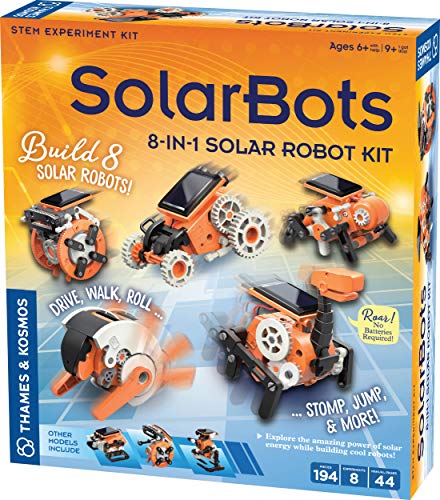
SolarBots 8-in-1 Solar Robot Kit
Editor’s pick · Thames & Kosmos

SolarBots 8-in-1 Solar Robot Kit

The one we'd hand a curious 8-to-11-year-old first. You snap together eight different little machines — a walker, a turtle, a spinning car — that each clip onto the same small solar panel, then carry them into the sun and watch them go with zero batteries. The genius is the "no batteries" part: it forces the lesson that the light itself is doing the work, and a kid feels it immediately when a cloud rolls over and the robot stops. Builds go together in minutes (no glue, no soldering), so the payoff is fast, and there are enough of them to fill a whole rainy-then-sunny weekend.

Builds: solar energy · mechanical building · cause & effect

~$27· See it on Amazon
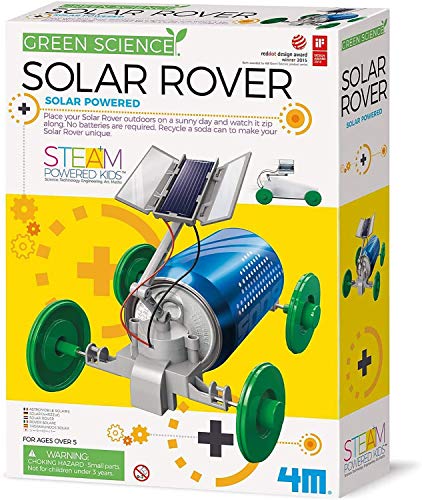
Green Science Solar Rover
Best for younger kids · 4M

Green Science Solar Rover

The gentlest on-ramp to solar, and the rare one a five- or six-year-old can mostly do themselves. You mount the little solar panel and motor onto a recycled drink bottle and the rover trundles across a sunny patio or windowsill. It's light on parts and forgiving — exactly what you want for a first build that has to end in success, not a meltdown over a snapped tab. The eco angle (reuse a bottle you'd toss) is a nice, honest bonus rather than the whole point.

Builds: first solar build · recycling · fine motor

~$20· See it on Amazon
Solar Race Car Experiment Kit
Best under $15 · Thames & Kosmos

Solar Race Car Experiment Kit

If you just want to test whether a kid likes this stuff before spending more, start here. It's one focused build — a little solar-powered race car — for the price of a couple of fast-food meals, and the included panel and motor are genuine Thames & Kosmos parts, not flimsy filler. The single goal keeps younger or easily-frustrated builders on track, and the moment the car takes off across the driveway under nothing but sunlight is the whole pitch for solar power in about four seconds.

Builds: photovoltaics · gear basics · single-project focus

~$13· See it on Amazon

For the kid who’s ready for more

Once a child has built a solar car and wants depth — more builds, real circuits, a bigger challenge — these reward the leap.

Solar-Powered Rovers Experiment Kit
Most builds · Thames & Kosmos

Solar-Powered Rovers Experiment Kit

Five different sun-powered vehicles and devices from one box, which makes it the best value-per-build on this list. Where the race car is a single project, this one keeps a kid coming back: build one rover, race it, take it apart, build the next. The instructions walk through what's actually happening at the panel, so it lands as a real experiment kit rather than a one-and-done toy. A solid pick for the eight-or-nine-year-old who's already shown they like tinkering.

Builds: solar energy · engineering · experimentation

~$20· See it on Amazon
Green Energy Electronics Exploration Kit
Best for circuits · Snap Circuits

Green Energy Electronics Exploration Kit

STEM.org authenticated

The step up for a kid who's outgrown "build a car" and is ready to ask how the electricity actually moves. This is the famous snap-together circuit system aimed squarely at green energy: the solar panel and a hand-crank generator plug into real circuits powering fans, lights, and sounds across 100-plus projects. Nothing to solder — the parts snap onto a grid — so it's safe and frustration-free while teaching genuine electronics. It's pricier, but it's a platform a child grows into for years, not a single afternoon.

Builds: circuits · renewable energy · electronics

~$44· See it on Amazon
How Solar Energy Works STEAM Kit
Best building system · Engino

How Solar Energy Works STEAM Kit

For the child who loves construction sets as much as science. Engino's rods-and-connectors system builds four different working models powered by a small solar panel, and the parts are part of a larger ecosystem, so they're compatible with other Engino kits you might already own. The included booklet does a genuinely good job explaining the why behind each model. It rewards kids who like to build big and tweak, more than those who want a quick single result.

Builds: solar energy · construction · systems thinking

~$28· See it on Amazon
SolarBots Cosmic Explorers Kit
Newest set · Thames & Kosmos

SolarBots Cosmic Explorers Kit

A fresher companion to the 8-in-1 SolarBots, with five robots that walk, crawl, spin, and roll — same battery-free, snap-build approach, different critters. Worth knowing it exists so you don't accidentally buy the same set twice: get this one if a kid already has the original SolarBots and wants more, or just prefers the look of these. Same sturdy parts and the same fast, sun-powered payoff.

Builds: solar energy · mechanisms · building

~$27· See it on Amazon
SolarBot.14 Transforming Solar Robot
Best for ages 10+ · Teach Tech

SolarBot.14 Transforming Solar Robot

A meatier build for an older kid (the box says 10+, and it means it). This transforming solar robot has more parts and a real assembly process, so it asks for focus and a bit of patience — which is the appeal for a tween who finds the quick-snap kits too easy. The reward is a robot that motors around in sunlight and looks genuinely cool. Skip it for under-nines; aim it at the kid who already finished a couple of simpler kits and wants the next challenge.

Builds: solar energy · mechanical assembly · patience

~$35· See it on Amazon

Beyond solar: the wider clean-energy lesson

Solar is one door into renewable energy. These two — wind and a saltwater fuel cell — widen the idea to "how do we make power without plugging in?"

Wind Power V5.0 Experiment Kit
Best beyond solar · Thames & Kosmos

Wind Power V5.0 Experiment Kit

The natural companion if you want to widen the lesson from "the sun" to "clean energy" generally. You build a three-foot-tall working wind turbine that actually generates electricity to charge a small store and power a model — turning real wind (or a fan) into watts. It's a bigger, more ambitious build than the solar cars, and seeing a turbine the kid built spin up and light something is a memorable payoff. A great second clean-energy kit after a solar one has hooked them.

Builds: renewable energy · engineering · aerodynamics

~$45· See it on Amazon
Saltwater Fuel Cell Robot Kit
Best surprise · Thames & Kosmos

Saltwater Fuel Cell Robot Kit

Not solar, but it belongs in the same conversation and kids find it astonishing: this little robot walks for up to an hour on a single drop of salt water, no batteries at all. It's the most "wait, how is that even working?" kit on the list, which makes it a fantastic complement to a solar car — together they show two totally different ways to power a machine without plugging anything in. Build is simple enough for the 8-plus crowd and the payoff genuinely surprises grown-ups too.

Builds: clean energy · chemistry · building

~$30· See it on Amazon

A note on sunlight (read before you buy)

The single most common disappointment with solar kits isn't the build — it's a gray afternoon. These run on direct sun; a bright window often isn't enough to get a motor spinning at full tilt, and a dim room won't do it at all. The fix is easy: take them outside on a clear day, or aim a strong LED or halogen flashlight at the panel for indoor testing. Set that expectation with a kid up front and the kit becomes magic instead of a letdown. It's also, genuinely, the lesson — the light is the fuel.

How much to spend

You can spend very little here and still get the real thing. The Solar Race Car is around $13 and uses genuine parts — the perfect way to test interest. The $20–28 sweet spot (SolarBots 8-in-1, the 4M Solar Rover, Solar-Powered Rovers, and Engino's set) is where most generous gifts land and you get multiple builds. Above that, the Snap Circuits Green Energy kit and the Wind Power turbine are platforms a child grows into for years — worth it for the kid who's already shown the spark.

Frequently asked questions

What is the best solar panel kit for kids?
For most kids ages 8 to 11, our top pick is the Thames & Kosmos SolarBots 8-in-1 Solar Robot Kit — eight battery-free machines that run on one small solar panel, snapping together in minutes. For a younger child (5 to 7), the 4M Green Science Solar Rover is a gentler first build, and if you just want to test interest cheaply, the Thames & Kosmos Solar Race Car is under $15. Every kit in this guide comes from an established STEM maker like Thames & Kosmos, 4M, Snap Circuits, or Engino.
What age are solar panel kits for?
Most genuine solar kits are labeled 8 and up, because the panels, motors, and small parts need careful handling and the science lands better around that age. There are good exceptions for younger kids: the 4M Green Science Solar Rover and the basic Thames & Kosmos solar builds work well from about 5 or 6 with a grown-up nearby. At the other end, the Teach Tech SolarBot.14 is a meatier 10+ build for tweens who find the quick-snap kits too easy.
Do solar kits work indoors, or do you need a sunny day?
They need real, direct sunlight to run well — that is the honest catch with every solar kit. A bright window helps but is usually too weak to get a robot moving at full speed; outdoors on a sunny day is where they shine, literally. A strong halogen or bright LED flashlight can stand in for the sun for testing, which is handy on a cloudy afternoon. This sun-dependence is actually part of the lesson: kids see firsthand that the light is the fuel.
Do solar panel kits need batteries?
No — and that is the whole point. Every solar kit here runs on its included solar panel with no batteries at all, which is exactly what teaches the concept: the sunlight is doing the work. It also means no dead-battery disappointment on gift morning. (The one wrinkle: a couple of the broader clean-energy kits in this guide, like the Snap Circuits set, include a hand-crank generator too, so kids can compare ways of making power.)
Are solar kits good for school science projects?
Yes — they are a classic science-fair choice because the cause and effect is so clear and easy to measure. Kids can test how the angle of the panel, the brightness of the light, or the time of day changes how fast the motor runs, and write up real results. Kits with multiple builds, like the Thames & Kosmos Solar-Powered Rovers or the Snap Circuits Green Energy set, give the most room to design a proper experiment with variables to compare.

How we choose — and a word on the links

Educational Toys Planet has specialized in learning toys since 2004. We pick independently, only from established makers, then cross-check every candidate against current availability and the major independent award and expert lists. We don't accept payment for placement.

Affiliate disclosure: the product links here are Amazon Associate links. If you buy through them we may earn a small commission at no extra cost to you — that's what keeps these guides free and updated. Prices change; tap through for Amazon's current figure. Last updated June 2026.

Related guides