


Best Mechanical Kits for Kids (2026)

The best mechanical kits build something that actually works. Not a model that sits on a shelf — a contraption a child assembles and then sets in motion: gears that mesh and spin, a motor that drives real wheels, a pulley that lifts, a marble that loops back to the top. That moment a kid flips the switch on a machine they built themselves is the whole point.

We kept only kits we'd actually give a child — every one from a maker with a real track record, spanning chunky preschool gears to nuts-and-bolts builds for older kids, with a genuine reason (and the honest caveats) behind each pick.

🧸 Curating learning toys since 2004 Independent picks · no pay-for-placement

How to pick the right mechanical kit

Three things sort the good gift from the frustrating one: age, power source, and how open-ended it is. Age matters most — a 4-year-old needs chunky gears with no instructions, while an 8-year-old wants small parts and a real principle to chew on; put a curriculum-grade levers kit in front of a preschooler and it just becomes loose parts on the floor. Power splits kits into hand-cranked (gears, levers, pulleys — no batteries, instant play) and motorized (a switch, moving parts, and a pack of AAs you'll want on hand).

The third question is whether you want a guided build or an open system. Single-model science kits like the robotic hand give one satisfying afternoon and a finished toy; construction systems like K'NEX and MECCANO rebuild into dozens of things and grow with a kid for years. There's no wrong answer — just match it to whether your child loves finishing a thing or loves tinkering forever.

Motorized kits that really move

The heart of "mechanical": flip a switch and the thing you built comes alive. These add a working motor, so the payoff is motion you can see, not just a static model.

25-in-1 Motorized Supercar Building Kit
Editor’s pick · MECCANO

25-in-1 Motorized Supercar Building Kit

This is the closest thing to a "grown-up" mechanical kit a 10-year-old can actually finish. You drive 347 real nuts and bolts into a metal-and-plastic chassis with the included wrenches and screwdriver, wire in a working motor, and end up with a car whose wheels and lights genuinely run. The 25-in-1 part matters: when the supercar gets old, the same parts rebuild into other vehicles, so it doesn't become a one-and-done shelf model. Fair warning — the build is long and a little fiddly, so it suits a patient kid (or one building alongside a parent), and it's the gift that teaches "righty-tighty" for real.

Builds: real fastening · mechanical assembly · following plans

~$42· See it on Amazon
Power & Play Motorized Building Set
Best motorized builder · K’NEX

Power & Play Motorized Building Set

529 rods, connectors, and a battery motor that turns any build into a machine that actually moves. K'NEX is the rare construction system where a kid graduates from "looks like a crane" to "the crane lifts," and that jump from static model to working mechanism is the whole point of a mechanical kit. The instructions walk through several motorized models, but the parts are open-ended enough that the real fun starts when they go off-book. Best for 7+ who already like building — younger kids find the rods stiff to click together at first.

Builds: structural engineering · gear & motor basics · spatial reasoning

~$47· See it on Amazon
Marble Run with Motorized Elevator (150 pieces)
Best motion machine · National Geographic

Marble Run with Motorized Elevator (150 pieces)

Most marble runs end when the marble hits the bottom; this one adds a motorized spiral lift that carries marbles back to the top, so a well-built track runs in a continuous loop — a "perpetual-motion machine" that genuinely delights kids. Building it teaches systems thinking: a gap or a too-shallow slope anywhere and the marble stalls, so kids learn to test, watch, and fix. 150 pieces is enough for real height and a couple of paths. The motor needs batteries, and ambitious towers can get tippy, so a flat table helps.

Builds: planning a system · cause & effect · spatial reasoning

~$48· See it on Amazon
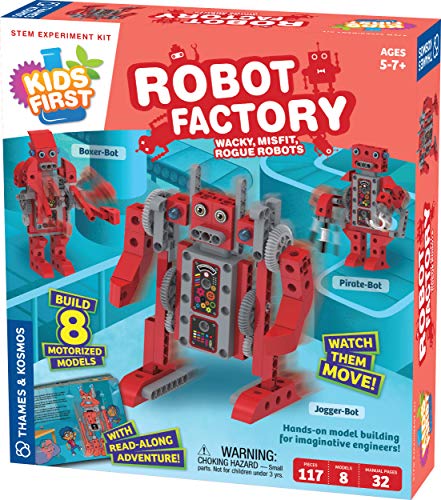
Kids First Robot Factory Motorized Kit
Best for ages 5–7 · Thames & Kosmos

Kids First Robot Factory Motorized Kit

Mechanical building for the younger sibling who isn't ready for tiny rods and ratios. Kids assemble eight goofy motorized robots from chunky, easy-connect parts and a battery motor box, then watch them wobble, spin, and trundle across the floor. The "wacky misfit" theme keeps it playful rather than schoolish, and the storybook-style manual is genuinely usable by a 5-to-7-year-old. It's a real intro to motors and moving parts disguised as a toy — and a Thames & Kosmos kit, so the engineering under the silliness is sound.

Builds: mechanical assembly · cause & effect · imaginative play

~$30· See it on Amazon

Gears, levers & the building blocks of machines

Before motors there are the simple machines — gears, levers, pulleys. These teach the principles every engineer leans on, from a chunky preschool set to curriculum-grade kits.

Gears! Gears! Gears! 100-Piece Deluxe Building Set
Best for ages 3–5 · Learning Resources

Gears! Gears! Gears! 100-Piece Deluxe Building Set

The gentlest on-ramp to "machines" for a preschooler. Kids snap chunky interlocking gears onto a base, give one a turn, and watch the motion ripple across the whole contraption — pure, visible cause-and-effect with no batteries or instructions required. It's our pick for the 3-to-5 crowd because the pieces are big, forgiving, and nearly indestructible. The one thing to coach early: gears only spin when they actually mesh, so the first few builds go smoother with a grown-up nudging pieces into place.

Builds: cause & effect · fine motor · early engineering

~$22· See it on Amazon
Design & Drill Gears Workshop
Best first mechanism · Educational Insights

Design & Drill Gears Workshop

A real kid-safe power drill plus a board of gears — so a preschooler builds a turning mechanism and operates the tool that assembles it. Kids bolt colorful gears to the workshop, then pull the trigger and the whole train spins; reversing the drill takes it apart again, which buys a surprising amount of independent, focused play. It's the toy that builds genuine hand strength and a first taste of "I made the tool do the work." It buzzes — not a silent toy — but that little motor is exactly what they'll love.

Builds: fine motor · tool use · cause & effect

~$23· See it on Amazon
STEM Explorations: Levers & Pulleys Building Kit
Best for simple machines · K’NEX

STEM Explorations: Levers & Pulleys Building Kit

The "why does this make lifting easier?" kit. Kids build working levers and pulley systems, then feel for themselves how a lever or a block-and-tackle multiplies their effort — the foundational mechanical ideas every later engineering class assumes you've touched. It comes with activity-style challenges that nudge kids to predict, build, and compare, which is exactly how this stuff sticks. Aimed at 8+ and genuinely curriculum-grade; it's more "learn a principle" than free-play, so pair it with an open builder if your kid wants both.

Builds: mechanical advantage · physics intuition · problem solving

~$18· See it on Amazon
STEM Pulley Drives Building Set
Best belt-drive kit · Engino

STEM Pulley Drives Building Set

Engino's parts click together fast and rigid, and this set is built around belts and pulleys — so kids construct drive systems and see how changing a pulley's size speeds up or slows down what it turns. Eight model options take a child from a simple driveline to more involved contraptions, and the booklet explains the mechanical principle behind each. It's a step up in precision from chunky preschool gears: better for a 9+ who's ready to think about ratios, not just "make it spin."

Builds: gear & belt ratios · engineering design · fine motor

~$35· See it on Amazon

Circuits & no-battery mechanisms

Two more flavors of "kit": wiring up working electronics, and mechanisms powered by gravity and a kid's own planning. Both build the same tinker-test-fix muscle.

Snap Circuits Jr. SC-100 Electronics Kit
Best electro-mechanical · Snap Circuits

Snap Circuits Jr. SC-100 Electronics Kit

The mechanical cousin every tinkerer should meet: instead of bolts, kids snap color-coded components onto a grid to build over 100 working projects — a spinning fan that launches into the air, a motor, sirens, lights. The snap design means no soldering and no frustration, so a kid actually finishes circuits and sees them do something physical. It's the gateway from "machines that move" to "machines you wire up," and the manual builds difficulty gradually. Needs a few AA batteries; the SC-100 is the right starter size before the bigger 300/500 sets.

Builds: circuit logic · cause & effect · following diagrams

~$30· See it on Amazon
KidzLabs Robotic Hand Kit
Best under $15 · 4M

KidzLabs Robotic Hand Kit

A single, satisfying build that punches way above its price: kids assemble a wearable robotic hand whose fingers actually grip when you pull the tubes — a hands-on lesson in how tendons and linkages translate one motion into another. It's a great low-stakes first "mechanism" project, and the finished hand is a genuine toy kids keep playing with, not a model that just sits there. Aimed at 8+; expect about an hour of assembly, and a little adult help threading the lines goes a long way.

Builds: mechanical linkages · how the body works · patience

~$15· See it on Amazon
Gravity Maze Marble Logic Game
Best no-batteries · ThinkFun

Gravity Maze Marble Logic Game

Toy of the Year nominee · Oppenheim winner

A mechanical kit doesn't have to have a motor — this one runs on gravity and your kid's planning. You arrange clear towers so a dropped marble threads an unseen path from start to target, working through 60 challenges that climb from gentle to genuinely hard. It teaches the same plan-test-adjust loop as a marble run, but as a solo brain game with a satisfying clack when the marble lands. Our pick for a screen-free 8-to-12-year-old who likes puzzles, and it travels well — no parts to plug in or lose down the back of the couch.

Builds: logical reasoning · spatial planning · persistence

~$20· See it on Amazon

How much to spend

You don't need to spend much to get a genuinely good first mechanism. The under-$25 picks here — the 4M Robotic Hand, K'NEX Levers & Pulleys, the Gears! Gears! Gears! set, Design & Drill Gears, and Gravity Maze — each teach a real principle and stand on their own. The $30–48 range (MECCANO supercar, K'NEX Power & Play, the motorized marble run, Snap Circuits Jr.) buys motorized action and a kit that rebuilds for years — that's where most generous birthday gifts land, and where the cost-per-hour gets tiny.

Frequently asked questions

What is a mechanical kit for kids?
A mechanical kit is a build-it-yourself set where the finished project actually does something — gears that turn, a motor that drives wheels, a pulley that lifts, a marble that loops. The point isn’t just a static model; it’s a working mechanism a child assembles and then operates. That spans chunky preschool gear sets, motorized construction systems like K’NEX and MECCANO, simple-machine kits (levers and pulleys), electronics sets like Snap Circuits, and even gravity-powered marble logic games. Every kit in this guide comes from an established maker like Learning Resources, K’NEX, Educational Insights, or National Geographic.
What age are mechanical kits best for?
It depends on the kit, which is why this guide spans ages 3 to 12. For ages 3–5, start with chunky gears that need no instructions — the Learning Resources Gears! set or Educational Insights Design & Drill Gears Workshop. Ages 5–7 are ready for guided motorized builds like the Thames & Kosmos Robot Factory or a National Geographic marble run. From 7 or 8 up, kids can handle small parts and real principles: K’NEX motorized and levers-and-pulleys sets, Snap Circuits, and the MECCANO supercar. Always check the age on the box — small parts and long, fiddly builds frustrate kids who aren’t there yet.
Are MECCANO and K’NEX the same as LEGO Technic?
They overlap but feel different in the hand. LEGO Technic builds detailed models with beams, pins, and gears and tends toward licensed cars. MECCANO uses real metal-and-plastic parts joined with actual nuts and bolts you tighten with included tools — the most "real engineering" feel, and the reason we made the motorized supercar our top pick. K’NEX uses rods and connectors that snap into large, strong frameworks, great for motorized rides and big structures. None is "best" outright; MECCANO rewards patience, K’NEX rewards scale, and Technic rewards detail.
Do mechanical kits need batteries?
Some do, some don’t — and we’ve flagged which in each pick. Motorized kits (the MECCANO supercar, K’NEX Power & Play, the National Geographic motorized marble run, Thames & Kosmos Robot Factory) and Snap Circuits need AA batteries, usually not included, so grab a pack. The gear, lever, and pulley sets are powered entirely by hand — you provide the crank. And the ThinkFun Gravity Maze runs on gravity alone. If you want zero batteries and zero fuss, start with the Gears! set, the levers-and-pulleys kit, or Gravity Maze.
What do kids actually learn from a mechanical kit?
The real lesson is cause and effect you can hold: change one part and watch what happens downstream. Gear sets teach how motion transfers and how ratios change speed; lever-and-pulley kits teach mechanical advantage (why a tool makes lifting easier); motorized builds connect a power source to moving parts; circuits add how electricity makes things go. Underneath all of them is the engineering loop that matters most — build, test, notice it failed, figure out why, and fix it. That patient troubleshooting is the skill that carries far past the toy.

How we choose — and a word on the links

Educational Toys Planet has specialized in learning toys since 2004. We pick independently, only from established makers, then cross-check every candidate against current availability and the major independent award and expert lists. We don't accept payment for placement.

Affiliate disclosure: the product links here are Amazon Associate links. If you buy through them we may earn a small commission at no extra cost to you — that's what keeps these guides free and updated. Prices change; tap through for Amazon's current figure. Last updated June 2026.

Related guides